


Negative thoughts are pushy little mojo-stealing pirates. They are persuasive, intrusive, and powerful. Our thoughts will influence how we feel, which will influence what we do and how we see ourselves. For our children and teens, negative or anxious thoughts can shrink their world and dilute their capacity to own their very important place in it. Negative thoughts will do that with all of us.
It isn’t so much the thoughts that are the problem, but what those thoughts are allowed to become. Negative thoughts that come and go without settling in are no problem at all. We all have them from time to time – sometimes plenty of times. The ones that cause trouble are the ones that swagger in, claim their place at the table, and outstay their welcome. Even more boldly, they’ll run a convincing argument that must stay to protect those minds and bodies from harm – and embarrassment, humiliation, failure, making a mistake, might all count as harm.
If only negative thoughts could find their way out as easily as they find their way in, but negative thoughts don’t tend to work that way. In fact, the more we try to push them out, the more they’ll push back. When we slam the door, they’ll hustle through the window. When we run, they’ll chase.
If your children are being barrelled by negative thoughts, it’s likely that you’re all too aware of the resilience of those negative thoughts. They won’t ease by telling your child not to think them, not to worry about them, not to listen to them, or by arguing about the rightness or wrongness of those thoughts. For something that can’t be seen, touched, or boxed and put on the high shelf, negative thoughts can make us all feel helpless – but there is a way to change that.
Our children have enormous power to shift their negative thoughts into something that is more able to nurture, nourish and strengthen them. The secret is making them realise this, and helping them to discover their power. Here’s how to do that.
Now for the best type of explanation – one they can experience.
Try this with your children …
‘Do NOT to think of pink elephants. Whatever you do, don’t think of pink elephants. Do NOT think of pink elephants with big sunglasses and fluffy pink coats and shiny pink leggings. Do not think of pink elephants. Seriously! Stop! Don’t think of pink elephants. Have you stopped thinking of pink elephants yet? You know, the ones in the coats and the leggings – the pink ones?
Now … think of blue monkeys. Imagine big, fluffy, friendly, blue monkeys swinging from vine to vine. Imagine blue monkeys everywhere. Imagine big huddles of blue monkeys eating banana bread, telling jokes and laughing so hard they fall on their fluffy blue bottoms. Dark blue, light blue, middle blue – so many blue monkeys.
What’s happened to your pink elephants now?’
Here’s how it works. It’s precious real estate up there in the your head, and there’s only so much thinking space our thoughts can occupy. That space can be taken up with negative thoughts or positive thoughts or both. The more negative thoughts there are, the less positive ones there will be. You’ve probably seen way too much evidence of this. The great news is that it also works the other way – the more positive thoughts there are, the less space there is for negative ones to set up camp. This isn’t a passive process though. Our children need to understand that they have a lot of power in controlling which thoughts take up their ‘thinking space’. If they think more positive, strong, brave thoughts, eventually negative thoughts be squeezed out of business. Of course they’ll still have anxious thoughts sometimes, but with more strong, brave thoughts on board, it will be less likely that those anxious thoughts will dig in have more influence over feelings and behaviour than they deserve.
So ‘not thinking’ about thoughts makes us think them. How does that work?
Research by Daniel Wegner, a professor at Harvard University, found that when we try to not think of a thought, one part of our mind will avoid the thought, but another part will keep checking to make sure the thought isn’t coming to mind. It’s ironic, but the process our minds engage to not think the thought, actually makes us think the thought.
Now that they understand the concept …
Now that you’ve demonstrated the power of positive thoughts to keep the negative ones under control, the next step is to help your kiddos find their own brave, strong, thoughts.
It’s important that all children and teens understand the power they have to change and strengthen their brain. This starts with knowing that it’s possible. Explaining the science will support this:
‘Every thought, feeling and action creates a pathway in your brain. These pathways are important because it’s how the information travels from one part of the brain to the other. Whenever you do something over and over, that pathway becomes stronger and stronger. The stronger the pathway, the stronger that part of your brain, and the easier that behaviour, thought or feeling will be.
Thoughts can release brain chemicals (neurotransmitters) and electrical impulses that create pathways in the brain. This is why it’s so important that your thoughts are healthy, positive and strong. When you think brave, strong thoughts, ‘I can do that’, or ‘whatever happens I’ll be okay,’ those thoughts form a pathway. The more you think those thoughts, the more real they’ll feel. This is also the way for anxious thoughts. The more you think anxious thoughts, the more anxious thoughts you’ll think – so it’s important to think strong, brave thoughts whenever you can. Brave thoughts (‘I can do this’) lead to brave behaviour. Calm thoughts (‘Breathe in … Breath out …’) lead to calm behaviour.’
‘But I have a really strong brain – like, really strong – and sometimes it’s determined to think anxious thoughts. What then?’
Anxious thoughts are a sign of a strong, healthy brain doing exactly what strong healthy brains are meant to do – keep us safe. We humans are designed to pay more attention to threats and negative information than to positive information. This is because for our survival, it’s more important that we’re aware of the things that could hurt us than the things that could make us happy. This can be annoying, because it means that anxious thoughts will often happen easier than brave or happy thoughts BUT all of us have the power to retrain our brain towards braver, stronger, more positive thinking. To help kids take back control and be the boss of their brain (and their thinking), it can help to introduce them to the part of the brain that is responsible for filling their heads with negative thoughts. Here’s how:
‘The main part of the brain that takes responsibility for keeping us safe is the amygdala – a very small but very powerful part of your brain that is there to warn us of danger and prepare us to respond. The amygdala takes its job VERY seriously. It’s like your own fierce warrior, there to protect you but sometimes it can take it can work a little too hard, scanning the environment constantly, and warning you of danger when there’s really nothing at all to worry about. Humiliation, embarrassment, being separated from someone you love, missing out on something important, having things not turn out as planned, making mistakes – these all count as potential threats to an amygdala that is fiercely dedicated to keeping you safe and sound. If thoughts are coming from big feelings – sadness or anger, it’s also likely that the amygdala is involved.
Your amygdala will be super-quick to take control if it thinks you’re in danger. When this happens, it get your body ready to flee the danger or fight the danger. Even if you’re pretty sure there’s nothing to worry about, these feelings can make you feel as though there is. Anxiety is a sign that your amygdala is being a little overprotective, and taking over even when there is no need. There’s nothing wrong with this – it happens to all of us, but it’s important to know how to be the boss of your amygdala so it can’t worry you unnecessarily.
Here’s the powerful secret: Your amygdala will ALWAYS listen to you. It wants you to be brave – but you will need to be the boss. You and your amygdala are a brilliant team, but things will always work better when you’re the one in charge. Amygdalae are super-smart, but they can all ready things wrong sometimes. The key to finding calm and feeling brave is to find the words that will calm your amygdala. Perhaps your words will be something like, ‘I know you’re trying to look after me, but I can do this – I’ve done plenty of hard things before,’ or ‘Thanks amygdala for looking after me – you’re a legend, but I’ve got this,’ or, ‘Whatever happens I’ll be okay,’ or, ‘What if I say the wrong thing? Well, amygdala – so what if I do? And something else … what if I don’t!’
These words will shape stronger, braver self-talk. When they find their brave thoughts, let them know it’s not just about the words. It’s also about the tone and they way they feel when they think them. Encourage them to speak back to their anxiety (their amygdala) with as much certainty as their anxiety speaks to them.’
Now to power it up.
What we do with our physical selves can have a powerful effect on the way we feel. For example, research has found that when we reduce our physical presence (by crossing arms or legs, wilting, slouching, head down) we’re more likely to feel smaller, more anxious, or less powerful. On the other hand, expanding our bodies (think superhero poses) can make us feel more confident, less stressed and less anxious. What we do with our bodies, has a lot of sway with what happens inside them. In line with this, research has found that writing down negative thoughts, ripping them up and throwing them away makes it easier not to think about them.
‘When they threw their thoughts away, they didn’t consider them anymore, whether they were positive or negative.” – Richard Petty, researcher and professor of psychology at Ohio State University.
Even better, writing positive thoughts down on paper, and then putting the paper in a pocket to keep the thoughts safe, makes those thoughts more influential.
“This suggests you can magnify your thoughts, and make them more important to you, by keeping them with you in your wallet or purse.” – Richard Petty.
Ask your child to write (or draw) his or her negative thoughts on paper, rip them up, and throw them in the bin. Then, ask them to write their positive, brave thoughts on another piece of paper to keep in their pocket or under their pillow. Negative thoughts trashed, positive thoughts protected – and close.
But in the midst of anxiety …
Anxious thoughts can be exhausting for everyone. For something you can’t see and can’t touch, they certainly have a way of occupying space and time like they belong there. Anxious thoughts typically don’t like to be challenged. As any parent who has tried to argue against anxious thoughts would know, an anxious brain is a powerful brain, and it can be spectacularly resistant to logic and rationality.
‘But I don’t want to go to school. What if something happens to you while I’m not with you?’
‘But it won’t. I’m completely safe.’
‘Oh. Ok. Phew. Thanks letting me know. See you after school then …’ said no anxious child ever.
Conversations on replacing negative thinking with strong thinking have to happen during times of calm. An anxious brain is a busy brain, and laser focussed on staying safe. Assuring anxious kiddos in the midst of anxiety that there is nothing to worry about won’t help. The truth is that they are worried, and something doesn’t feel right. To an anxious brain, the only reason you aren’t worried is because you don’t get it. This can escalate feelings of helplessness and fear. The more you argue that they’re okay, the more they’ll argue back. An anxious brain is a strong brain, and it will defend its fears and anxious thoughts as hard as it needs to. The good news is that as strong as their anxious thoughts might be, your child will always be stronger. The trick is getting them to realise this, but there will be time for that when the anxiety has passed. In the midst of anxiety, what kids need is to know that your on their team, and you get it.
To do this, in the midst of their anxiety, ride the wave with them. Even if their fears don’t make sense to you, they make sense to them. Beneath every anxious thought is a valid fear or a valid need, often related to very important human needs such as security, safety, and ‘what will happen to me if …’. The thoughts that we hear might sound irrational, but that’s often because the real fears are difficult to shape into words. What kids need in the thick of anxiety, is warmth, validation and acknowledgement. Think of this like standing with them against their anxiety. They need to know you get it before they’ll open up to any challenge you might give their anxious thoughts. Try, ‘That sounds like a really scary thought.’ Then, breathe, be still, and be a strong steady presence as the wave subsides. During anxiety you don’t need to do any more than that. The work on helping them feel braver, stronger, and less vulnerable in the face of anxiety will be most powerful when they’re calm and able to take in new ideas and new information.
Strengthening positive memories will making positive thoughts easier.
Anxious thoughts are often driven by anxious memories, but research has found that these memories don’t need to come from actual experiences. Hearing about an emotional experience, such as via the news, a friend, or a story is enough to influence the amygdala. These experiences don’t have to be ‘big’ to assume influence. Hearing about an experience that was embarrassing, confusing or confronting for someone else, can be enough. These stories might not always be in awareness, but they can sit behind the scenes and drive worries, fear and negative thinking.
There’s good news though. The antidote to this is to build up the accessibility of positive memories. Research has found that gratitude can increase our tendency to recall positive memories. Positive memories will lead to positive thoughts. The research also found that the memories of grateful people had a more positive emotional impact on them, than the memories of less grateful people had on the less grateful.
Encouraging a regular gratitude practice will help to strengthen the tendency to recall positive memories, which will in turn help to tilt thinking towards the positive. Nurturing gratitude in kids can be done so simply. Before bed (or around the table/ in the car) ask them to name three things they’re grateful for. They can write them down in a gratitude journal, write them on pieces of paper and put them in a gratitude jar, or say them to you. It doesn’t matter how it’s done. The point is that thinking of things to be grateful for will encourage the memories that drive positive thoughts.
Our kids need to understand the importance of their thoughts. Brave thoughts make you feel brave. Coping thoughts will help you cope. Worrying thoughts make you feel anxious.
And finally …
All children have everything they need inside them to be brave, strong, and happy. The key is making sure they know this, and that they have the skills to keep watch over that precious part of themselves where their thoughts wander in and out of. Negative thoughts will come, and so will bad feelings. Some of them will scrape. It’s part of being human. What’s also part of being human is drawing on the well of courage and strength to push through negative thoughts and bad feelings. This is a skill that will develop over time, but first, our children need to know that they have the power to do this. This is important. What they think will affect the way they see themselves, which in turn will breathe life into the way they are.As the important adults in their lives, we have enormous power to give them the skills and wisdom they need to fuel the warrior inside them that will fight for them, believe in them and strengthen them from the inside out.
You might also like …
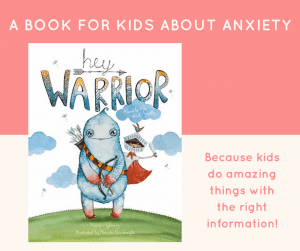 A Book for Kids About Anxiety …
‘Hey Warrior’ is the book I’ve written for children to help them understand anxiety and to find their ‘brave’. It explains why anxiety feels the way it does, and it will teach them how they can ‘be the boss of their brains’ during anxiety, to feel calm. It’s not always enough to tell kids what to do – they need to understand why it works. Hey Warrior does this, giving explanations in a fun, simple, way that helps things make sense in a, ‘Oh so that’s how that works!’ kind of way, alongside gorgeous illustrations. (See here for the trailer.)
Some great ideas here. As a YMCA gymnastics leader we’d have 5-12 year olds who would have minor injuries which hurt. Splinters, a knock or bump etc. and while cleaning the cut up we’d say…” it’s really important when you have a splinter / cut / bruise that you don’t think about Polar Bears.”
“What? Why not?”
“Stop… stop thinking about them”….
“But why? … what’s wrong with that?”
“Oh, ok, maybe you’re old enough that that’s ok… what do you think?”
Karen, truly a great article and explained fantastically well.
I was researching how to use “Don’t think of a…” as a coaching tool for dealing with certain aspects of stress and negative thinking. I think your article explains it all wonderfully!
Thank you for saving me 8 hours!
Great article! Helped me also as a parent to cope with anxiety.Thanks you so much.
My 6 year old is struggling with homesickness and cultural adjustment since we moved abroad 3 weeks ago (we will be here for about 7 months). Would these strategies be appropriate to help her find more that’s good/fun/exciting about where we are?
Always worth a try!
I just happened upon this site tonight while looking for support for my anxious 8yo. This is wonderful advice and I love your reassuring tone – nothing is one-size-fits-all but everyone can learn to find their strengths, with help and guidance. I was planning on reading my son part of one of your posts but was THRILLED to see that you have a book! It’s ordered and I think the language will benefit us all. Many thanks for your work!
Lena I’m so pleased the article was helpful. There is certainly not a one size fits all approach! And thank you for ordering the book. I hope it was able to help your son understand his anxiety more, and realise how brave he is inside.
Your post is very enlightening. Thank you.
This is such a great article, super helpful clear explanations. It would be great to see more articles on neuroplasticity
Summary of what i understood:
Focusing on avoiding thoughts and emotions just make it worse
Amygdala is what creates these emotions and Catastrophic thoughts.
I can communicate with Amygdala that I am ok and work with and noth against it.
Ideas that help me:
Visualize me being calm and confident. Visual imagery is powerful. For example, I see myself enduring the situation and being successful. In a sense that convinces your Amygdala that everything will be fine.
Nicely said.
As a parent it is SO helpful to read good articles like this – it keeps me patient. I fall into phases of wanting things to be normal. Easy. Appreciate the strategies.
Natasha I’m so pleased this was helpful for you.
HI….I have been struggling with myself trying to help my 13 year that seems to struggle with anxiety. She becomes so nervous before performing in a play, a presentation, or something that she is in the spotlight for. When she fights her fears and completes the task she always loves it and was happy she did it. It is the process of getting started that scares her. This article provided awesome advice for me and even a bit of an explanation of why.
I appreciate the idea of riding the wave of anxiety with her instead of talking at her about it while in the moment. Makes so much sense!!
Thank you!!
You’re so welcome Heather. It can be awful to watch them struggling – I really get it. I’m pleased this has helped make sense of what’s happening for your daughter.
You are so very wise Karen! I always love reading your posts. Thank-you!
Thanks Kate. That means a lot.