
0 items | AUD  0.00

There are currently no live webinars scheduled

Previous Live Webinars
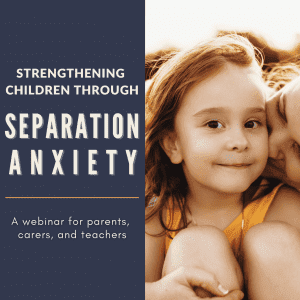
Separation Anxiety Webinar

Separation Anxiety: How to Build Their Brave

Separation anxiety can come with loads of heartache for children and their important adults, but there's something else it comes with - the opportunity to strengthen all children against anxiety and build their brave - and we know they can be brave.

Saying 'goodbye' can be tough! Not only for our children, but for us too - even the strongest and bravest of parenting hearts can feel the wrenching that can come at separation. Separation anxiety exists for a good reason. We want our children to feel loved and supported, and we also want to build their brave so anxiety doesn't stand in the way of the important, growthful things they need to do.

Of course we'd rather our young ones never feel the tailwhip of separation anxiety, but so many young people (and the adults who love them) are going to experience anxiety at separation from a loved one. It's part of being human, but it doesn't have to hurt. As their important adult, you have a profound capacity to support them through separation anxiety and help them feel braver, stronger, and closer to you, even when you're not beside them - at school, at bedtime - any time they are away from you. In this one-and-a-half-hour webinar, we will explore practical, powerful ways to do this.

This is information I wish every parent could have. I'll be speaking to you from my professional experience, but more importantly, I'll be speaking to you from my parenting heart. Something you might not know about me is that my own experience with my daughter's separation anxiety when she was a little person is what led me to this work. (She's now one of the bravest women I know!

I know we can get kids through separation anxiety. I know the heartache. I know the feelings of helplessness. And I know we can get them through. 

If you can't make the 'live' online event, that's no problem at all. A recording of the webinar will be made available to all registered participants for 30 days.

We will explore:

  • why separation anxiety happens, and the important job it's there to do;
  • the thing all loving adults will do (we'll all do them!) that can inadvertently make their anxiety worse, and what to do instead;
  • why their anxiety will fuel yours;
  • what adults can do to soften the impact of separation;
  • how to respond in the midst of anxiety - strategies for children, parents and carers (including teachers and other important adults);
  • practical ways to support your child through separation anxiety;
  • specific strategies for bedtime anxiety;
  • the toolbox for young people - how to help all children feel bigger at separation;
  • the connection between anxiety and aggression, and how to respond to big behaviour in the moment;
  • the connection between anxiety, behaviour and learning, and how to work with this;
  • a road map for supporting your child through anxiety - before, during, and after;
  • why relationships matter, and how to facilitate relationships between children and their important adults (teachers, other important adults) in ways that will build brave behaviour.
Thursday 08 February 2024, 6:30 pm-8:30 pm
Online
Registration Closed

Join our newsletter

We would love you to follow us on Social Media to stay up to date with the latest Hey Sigmund news and upcoming events.

Follow Hey Sigmund on Instagram

It’s the simple things that are everything. We know play, conversation, micro-connections, predictability, and having a responsive reliable relationship with at least one loving adult, can make the most profound difference in buffering and absorbing the sharp edges of the world. Not all children will get this at home. Many are receiving it from childcare or school. It all matters - so much. 

But simple isn’t always easy. 

Even for children from safe, loving, homes with engaged, loving parent/s there is so much now that can swallow our kids whole if we let it - the unsafe corners of the internet; screen time that intrudes on play, connection, stillness, sleep, and joy; social media that force feeds unsafe ideas of ‘normal’, and algorithms that hijack the way they see the world. 

They don’t need us to be perfect. They just need us to be enough. Enough to balance what they’re getting fed when they aren’t with us. Enough talking to them, playing with them, laughing with them, noticing them, enjoying them, loving and leading them. Not all the time. Just enough of the time. 

But first, we might have to actively protect the time when screens, social media, and the internet are out of their reach. Sometimes we’ll need to do this even when they fight hard against it. 

We don’t need them to agree with us. We just need to hear their anger or upset when we change what they’ve become used to. ‘I know you don’t want this and I know you’re angry at me for reducing your screen time. And it’s happening. You can be annoyed, and we’re still [putting phones and iPads in the basket from 5pm] (or whatever your new rules are).’♥️
What if schools could see every ‘difficult’ child as a child who feels unsafe? Everything would change. Everything.♥️
Consequences are about repair and restoration, and putting things right. ‘You are such a great kid. I know you would never be mean on purpose but here we are. What happened? Can you help me understand? What might you do differently next time you feel like this? How can we put this right? Do you need my help with that?’

Punishment and consequences that don’t make sense teach kids to steer around us, not how to steer themselves. We can’t guide them if they are too scared of the fallout to turn towards us when things get messy.♥️
Anxiety is driven by a lack of certainty about safety. It doesn’t mean they aren’t safe, and it certainly doesn’t mean they aren’t capable. It means they don’t feel safe enough - yet. 

The question isn’t, ‘How do we fix them?’ They aren’t broken. 

It’s, ‘How do we fix what’s happening around them to help them feel so they can feel safe enough to be brave enough?’

How can we make the environment feel safer? Sensory accommodations? Relational safety?

Or if the environment is as safe as we can make it, how can we show them that we believe so much in their safety and their capability, that they can rest in that certainty? 

They can feel anxious, and do brave. 

We want them to listen to their anxiety, check things out, but don’t always let their anxiety take the lead.

Sometimes it’s spot on. And sometimes it isn’t. Whole living is about being able to tell the difference. 

As long as they are safe, let them know you believe them, and that you believe IN them. ‘I know this feels big and I know you can handle this. We’ll do this together.’♥️

Pin It on Pinterest

Secret Link