
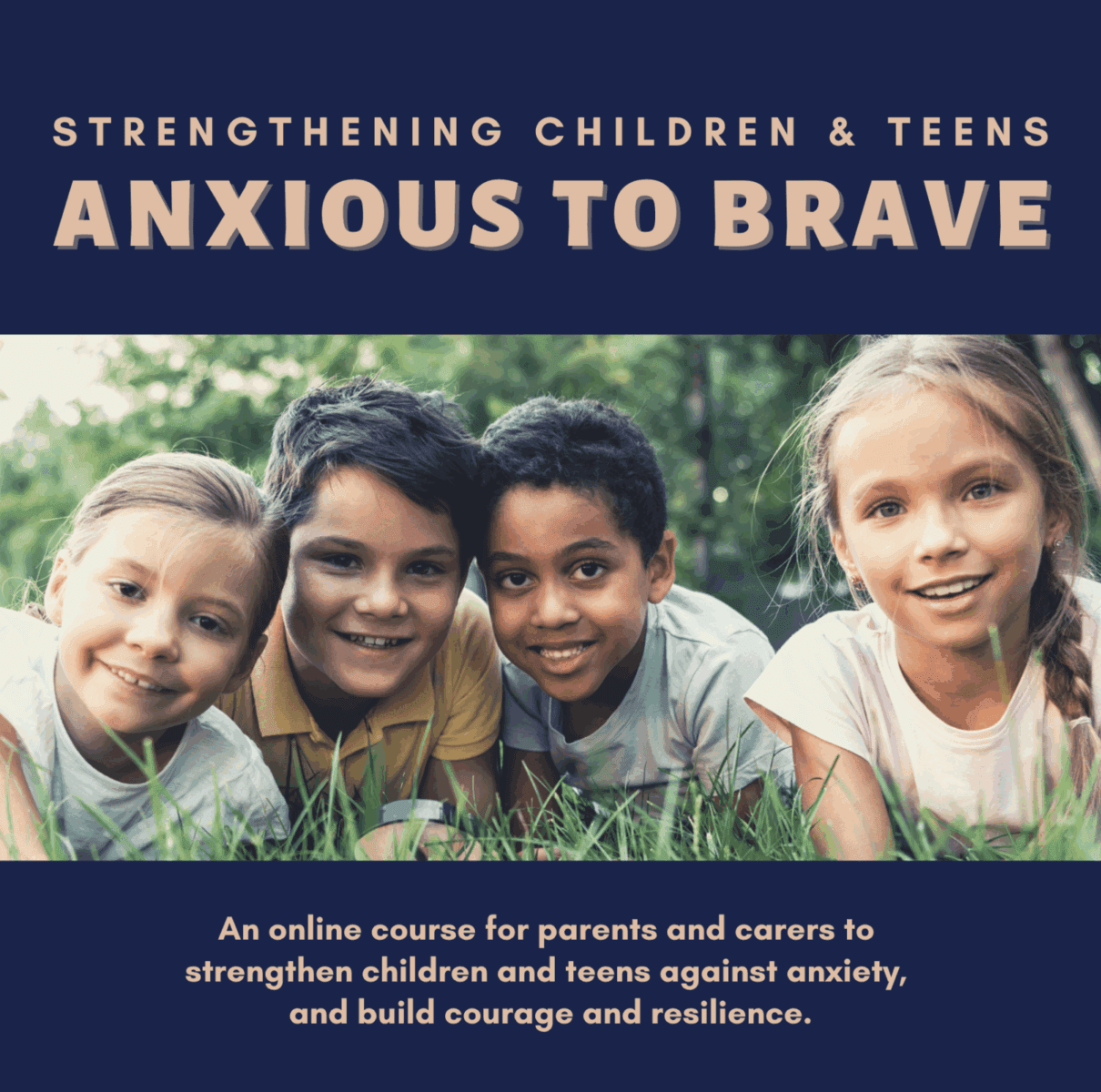
Anxious to Brave: On Online Course for Parents of Children and Teens With Anxiety
Children with anxiety have everything they need inside them to light up the world, but too often anxiety will tell them a different story. We know they are capable, brave, strong, and that anxiety doesn’t change that a bit. The challenge is to help them realise it too.
Research has shown that with the right support, information, and strategies, parents and carers have a profound capacity to move children and teens towards brave behaviour and strengthen them towards long-term courage, calm, and resilience. The move through anxiety isn’t an easy one, for children or the adults who love them, but it is absolutely possible. As part of this program, we will explore how.
This in-depth program will provide parents with research-backed information and strategies to strengthen children and teens against anxiety in the moment and for the long term. We will discuss the what and why of anxiety and how to open up a world for your child or teen where anxiety stops getting in their way, and brave behaviour becomes possible.
‘Anxious to Brave’ will also provide parents and carers with ways to support children and teens through big feelings (including anxiety, anger, meltdowns) and the range of behaviour that can be fuelled by those big feelings (including at school, bedtime, when faced with a challenge, or more generally). We will also discuss ways to empower children and teens with an understanding of their brain and body that helps make sense of feelings and behaviour, and opens up new ways to respond.
The ‘Anxious to Brave’ program consists of six online modules plus ‘mini videos’, totalling over 7 hours of content. Participants will receive workbooks and a 70% discount on the purchase of Hey Warrior, Ups and Downs, and The Hey Warrior Workbook. Access to the course will be available for 6 months from purchase. As part of the course, we will explore:
- Module 1:
- Turning anxiety into an ally. How, and why it’s so important.
- Using neuroscience to take the anxiety out of the anxiety.
- The single worst thing for anxiety (that every loving parent has likely done at least one or hundreds of times!).
- When anxiety fuels behaviour. How to respond, and why we need to rethink the old responses.
- Why parents are key to strengthening young people against anxiety.
- Module 2:
- How behaviours are built in the brain.
- Why old responses die hard and why new ones take time.
- Parents don’t cause anxiety, but here’s why you’re a powerful part of the solution.
- The responses (that all loving parents will do) that will inadvertently increase anxiety – why, and what to do instead.
- A proven way for parents to increase brave behaviour in children – making a step-by-step plan.
- When their anxiety becomes yours.
- Module 3:
- How the brain registers threat or safety – and what they need from you.
- The house model of regulation – how our nervous systems influence each other, and how you can use yours to bring calm to theirs.
- Practical strategies to build their capacity for calm, courage, and resilience.
- How to respond in the moment when anxiety hits in a way that helps build calm, connection, and maximises your influence and their capacity for brave behaviour.
- Co-regulation or co-dysregulation?
- Dealing with anxiety fuelled behaviour – during the storm, after the storm.
- Separation anxiety – practical examples and strategies to build brave.
- School anxiety and how to build their attachment village.
- Module 4:
- Anxiety – 4 Responses. Which one when.
- Building their Toolbox. The practical strategies for young people that will build calm, courage, and resilience.
- Making the move towards brave behaviour – the practical plan that won’t depend on their response or their willingness to engage;
- Module 5:
- The different ways your child might respond when their anxiety is big, and how to respond.
- Managing their reaction – the key strategies.
- When their reaction is especially big.
- The most important rule.
- Module 6:
- Proven strategies to strengthen against anxiety in the long-term.
- Practical strategies to reduce anxiety at bedtime and ensure a restful sleep – for everyone.
- ‘Stronger Than Anxiety’
- This is a video for children and teens to watch on their own or with you. It will introduce the language and concepts we’ve been discussing to make sure they feel as ready as possible to make the move towards brave. This module includes 20-page workbook, ‘Calming Your Amygdala’. In this module, we will explore:
- Why anxiety feels the way it does.
- Why anxiety always comes with courage.
- A way to think about anxiety that will help soften its impact.
- How to feel braver, stronger, and more powerful when you need to.
- How to calm anxiety.
- The connection between anxiety and your ‘thinking brain’ – and how to switch your thinking brain on.
- The things that will help anxiety in the moment and in the long term.
- This is a video for children and teens to watch on their own or with you. It will introduce the language and concepts we’ve been discussing to make sure they feel as ready as possible to make the move towards brave. This module includes 20-page workbook, ‘Calming Your Amygdala’. In this module, we will explore:
NOTE: This course includes ‘Stronger Than Anxiety’, a module specifically for young people to help them discover their own brave way through anxiety.
This course is intended to offer meaningful and impactful support to parents of children with anxiety. It is not therapy, nor is it intended to replace any therapy you or your child might currently be involved in. If your child is currently working with a therapist, please feel free to discuss anything you learn here with the therapist to ensure consistency of pacing, approach, and goals and timing.