
So we’re on the way to getting this ‘being human’ thing sorted. But there’s always room to push it a little.
One of the best parts of being human is that when we push ourselves at the edges, however it turns out, we still get to be human. We might bruise a little, sometimes a lot, we might fall – but it’s nothing we can’t deal with. Eventually we’ll find our feet, get up and dust off, usually better, stronger, wiser than before. We can be pretty amazing like that.
Something else might happen if we push ourselves. We might also lift. We might find something out about ourselves that’s surprising, exciting and pretty excellent. The things we hide under the history and habits, the shoulds and the shouldn’ts.
Change and flourish come from challenge, but challenge is individual – what’s challenging for you might be pedestrian for another, and what’s challenging for them, might be ‘meh’ for you. Here are some ideas for ways to stretch, push the limits and maybe uncover the potential of you just a little bit more – because it’s there. You don’t need to analyse it and you don’t need to know how it will end. Just step in and let go – even if only for short while – and see what happens …
-
Be vulnerable.
Being prepared to be vulnerable is the first step to all sorts of wonderful. It’s one of the hardest things and the best things. Vulnerability and courage are deeply connected and they always show-up together – always. One can’t exist without the other. Fear feels like a stop sign, but it’s not. It’s a sign that you’re about to do something really brave – life-changing even – that you’re on the brink of something beautiful.
Vulnerability is the deep breath in and the leap. It’s the courage and boldness to step forward when shame and fear are doing their best to hold you back.
For me, brilliant things have happened in those moments of absolute fear when I could have so easily chosen ‘no’, but chose ‘yes’ instead. They’re decisions that could have gone either way. They’ve existed side by side with breathtaking fear – but the decision to be vulnerable has brought enough courage for the fear not to matter enough. It doesn’t go away, it just doesn’t matter enough. That’s how it is.
Of course, my decisions to be vulnerable haven’t always ended with grace – sometimes I’ve fallen, maybe face planted once or lots of times – but none of the fallout is permanent. What I know for sure is that it’s because of those moments in which I’ve said ‘yes’, that I have many of the people, experiences and things that I would never want to be without. I wouldn’t have the relationships I have (‘but if I stay past ‘hello’ I might run out of things to say / say something stupid/ spill my drink down the front of my dress – all of these things have happened, but I’ve also fallen in love, discovered people I wouldn’t want to be without, learned things, made impressions). I wouldn’t have started running (‘Run? Um, yeah no. I can’t even run late without getting puffed and sweaty and gasping for breath on the floor – I still get puffed, sweaty and gasp for breath on the floor but at least now it’s when I’ve done more physical activity than stirring in a teaspoon of sugar). I wouldn’t have travelled (‘but I have no money, no idea and I’ve barely travelled past my mailbox -‘backpacking overseas? Yeah okay. Let’s go through the Middle East, hey?’) I wouldn’t have this website, which I love (the reasons ‘not to’ would fill a city library, but the reason ‘to’ (because it felt right) was bigger – and the only one that mattered).
If you were given a free pass to move towards something, knowing that whatever happened, you would be absolutely fine, what would you do? A new relationship? A new job? A holiday? An adventure? A new city? A hobby? Would you tell him (or her) how you really feel? Unless it involves swimming with sharks in a pool, chances are you’ll come out not-dead. What’s even more likely, is that you’ll come through having done something amazing.
-
Play
As humans, we’re not only capable of play, we’re meant for it. It’s one of the important ways we connect with other people and with ourselves. It forms the basis of successful relationships. Relationships in which people don’t play together eventually wither and die.
We know how important play is for children, but research is showing that it’s also important for adults. Play relieves stress, helps our relationships to thrive and develops the brain. As psychiatrist Dr Stuart Brown puts it, ‘Nothing lights up the brain like play.’
Brown suggests we integrate play into our lives, not just make time for it, by thinking back to our earliest memories of play and then working forwards to see where it fits in. There are so many different types of play – humour, sport (for fun – with a team), flirtation, movies, fantasy, games. Experiment – see which one fits best.
-
Love your body.
The thing about us humans is this: We all have a body and those bodies come in thousands of different shapes. It’s just the way it is so we need to deal with it. Worrying about the shape we come in is stopping too many awesome people from being seen, and the world is a little short on awesome people at the moment so can we just stop! The shape you come in doesn’t define you, but it might define the idiots around you who think it does.
There are few things more beautiful than someone who looks as though they love the skin they’re in. Maybe they actually do love it, maybe they don’t – who knows – but what I do know is that people who act as though they’re happy to be who they are are strikingly beautiful – whether they’re a size 0 or size 16 or beyond.’ It’s this way for people with lumpy thighs, skinny thighs, curved hips, no hips, flat tummies, unflat tummies, boobs, no boobs and cellulite. I don’t know who took these things out of the general definition of ‘beautiful’ but I, for one, am ready to see them go back in.
How would you be different if you celebrated your body instead of hid it? How would you sit? Stand? Talk? Dress? Be? Just try it for an hour. Then two. Then a day. Just start with five minutes if you want. There’s nothing to lose – for the moment it’s just pretending. You don’t actually have to like your body. You just have to act as if you do. You can always go back to the old way if you want. But just try it – and be open to liking how it feels.
-
Act as though everything is geared in your favour.
Too often the biggest thing standing in our way is ourselves. There will always be reasons to hold back but they’re often not as honest as the reasons to move forward. As humans, we’re hardwired to detect threat and to act on that. It’s called a negative bias and it can be so convincing! It wraps us up in a warm bundle of ‘just don’t go there, K?’ and holds us tight – too tight sometimes – but that’s its job, to keep us safe.
The thing is, just because there are reasons not to move forward, doesn’t mean those reasons are worth holding ourselves back for. How would you be different if you knew beyond doubt that everything that happened to you today, and all the days after that, were to move you forward? What would you do? What would you try? How would you ‘be’ in the world? What would people see? What would you say? Who would you say it to?
Try acting as if there was nothing in your way, even if it’s just for the first five minutes of leaving the house. It might feel awkward at first. New things always do. But it’s just a habit like any other. The more you do it, the more you’ll believe it. There’s always less standing in your way than you think there is.
I know this works because I do this regularly myself. Being in a room full of strangers tends to unsettle me – and by unsettle, I mean it kind of terrifies me. There was a time where I would always be late to things because I would be stuck deciding whether or not I would just be best to stay at home and home-tattoo the alphabet into the soles of my feet – it seemed like a reasonable alternative. Both equal in pain value. For a while now, I’ve been going into these things acting as though nothing could go wrong and as though everything that was about to happen was going to work in my favour. That makes them kind of exciting – the discovery, the potential, the possibilities. It’s a way to deal with anxious energy and make it positive. Anxiety is energy. Being anxious about an outcome means you focus on the things that could go wrong. Turning this around and acting as though everything that happens will be good for you means you are more likely to focus on the possibilities. Research has found that the effects of changing outlook in this way are real. Science, you make sense of things – and this is why we love you.
There are plenty of ways to stretch. These are only 4 of them. Often, it’s the times we need to feel brave that we feel least brave of all. That’s okay, and so normal. It’s a sign that we’re at the edge of ourselves and about to move beyond it. It means something exciting is about to happen, so let go – take a risk, play, love your body, believe that the world is working hard for you.
If you don’t feel brave, fake it. They look the same from the outside and will lead to the same extraordinary things.
I’d love to hear about the times you’ve pushed past your edges and done something brave. We’ve all done it and we’ve all got it in us to do more. You just never know who you’ll be inspiring.
Now, go be awesome. You’ve got a cheer squad here no matter what.
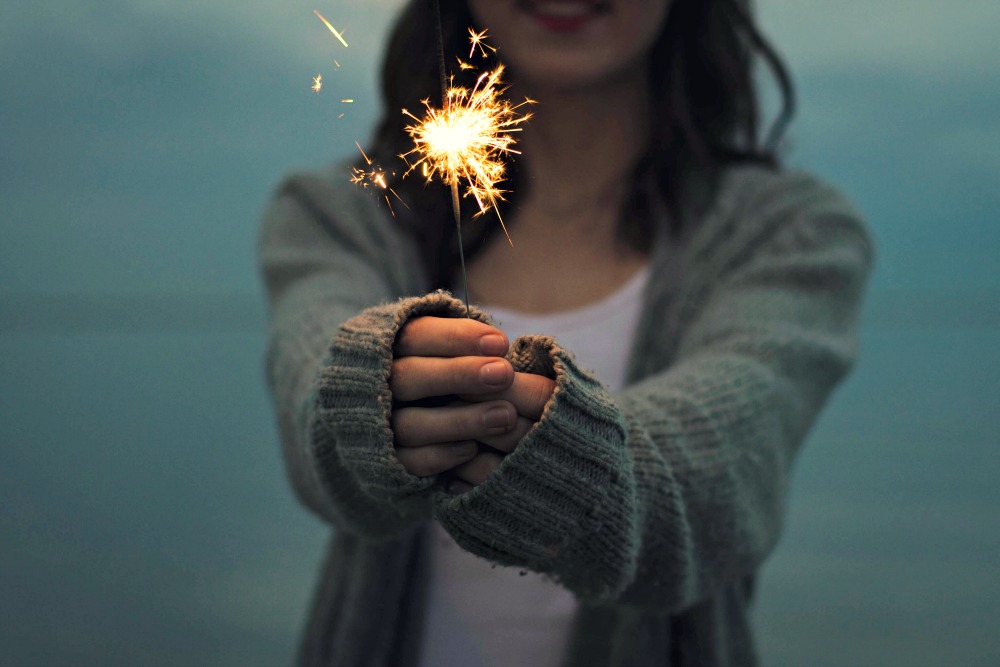
(Image Credit: Unsplash | Morgan Sessions)



This is a wonderful article. Thank you so much for all the knowledge you bring. My challenges with Mental Illness and Emotional Abuse have caused fear in my life to disclose anything. Starting my blog and uncovering what has been unspeakable has been freeing. Yes, this was fearful but I took the leap and I’m learning and growing. Your blog is so inspiring, and helpful in many areas. Looking forward to more.
You’re so welcome. I’m so pleased you’re writing. It sounds as though you have been through a lot and you will have amazing wisdom and insight. You’ll never know who you’ll be inspiring, but I’m sure it will be many.