


0 items | AUD  0.00

Sassy Bossy Back Talk – Understanding Why It Happens and What to Do

Sassy Bossy Back Talk - Understanding Why It Happens and What to Do

The smile that lights up your day; that laugh that warms you up with joy and optimism; the ability to show you the world through innocent eyes: kids can be such amazing parts of our lives with their constant ability to learn and grow, teaching us how to see the big picture and to love someone so much it hurts.

And then they learn the word “No.”

It can be a shock to the system when your little angel, who so recently curled up on your lap and thought you were the coolest thing on the planet, suddenly starts rolling their eyes at your requests or talks back with sarcastic comments. How did they learn that kind of sass? What makes them think they can get away with being a smart aleck? The nerve!

This type of behavior is absolutely normal and developmentally appropriate. When they’re being sassy, there’s usually something underneath that, driving that behavior. Kids often use this kind of talk to feel powerful, so it’s a clear indicator that your child is feeling powerless.

Sure, snarky communication is a normal developmental process for kids, but it doesn’t make it easier to swallow. How quickly those warm fuzzy feelings you had about your child can be tainted with annoyance, frustration, and anger. So it is important that we look underneath the surface so we can determine what is driving the behavior so we can determine the best way to respond.

Five Solutions for Sassy Back Talk

  1. Be a detective.

    First, identify how you feel. Ask yourself, “What is this bringing up for me right now?” If you feel an overwhelming sense of anger, acknowledge it, but don’t let it dictate your discussion. Or if you feel the impulse to “be the boss,” it’s a good indicator that you feel like you’re losing control. This is a good time to take a breath and look at the bigger picture.

    Then, assess how your child feels.

    Many parents fall into knee-jerk reactions to what their child is doing rather than why their child is doing and thus the behavior continues.

    Instead of getting caught up in your own frustrations, learn what your child’s point of view is. Ask warmly, “What’s going on, honey?” or for younger kids, closed-ended questions like, “Do you feel frustrated?” “Do you feel like you’ve been bossed around all day, or do you need some attention right now?”

    Most importantly, don’t tell your child how they feel—it’s not helpful and can lead to more resistance.

  2. Respond with empathy.

    Kids don’t make the choice, ‘I’m going to be a smart aleck right now to see what happens’—that behavior is driven by their needs and emotions. They’re just being reactive to their emotional state without knowing why.

    So once you uncover those needs and emotions, respond to them with warmth and understanding, while setting clear expectations for behavior. This might sound something like, “Wow, you sound really frustrated that you cannot have your ice cream before dinner. It’s okay to feel frustrated, but it’s not okay to roll your eyes and talk to me like that.”

    Then you can compassionately engage your child in problem-solving and finding other ways to get their needs met. If your child is acting out with snotty remarks, and you’ve determined they just need your attention, offer them alternatives. “Remember when I was on the phone yesterday and you asked me to play Legos with you? What was that thing you said that worked so well?” or “What’s another way you can get my attention?” or even, “You know, when I was a kid, here’s what I did to get my dad’s attention, and it worked!”

  3. Use enforceable statements.

    Have you ever been out to eat and your child made a scene? If you’re like most parents, you may have gone immediately for the big guns: “If you don’t cut it out, we’re going home.”

    Did they cut it out? Likely not. Did you go home? Likely not.

    Coming right out of the gate with a threat doesn’t always work with children because it doesn’t address their need behind the misbehavior. It just tells them they need to behave in a different way, and their needs may never get met. Not a fun prospect, is it?

    And worse, if you don’t follow through, your child will learn you don’t actually mean what you say, and they will continue to test your boundaries.

    Enforceable Statements are simply you respectfully stating what you’re willing to do or allow. That way if your child continues to be a smart aleck, they learn this is not an effective way of getting a parent to do what you want them to do.

    This may sound something like, “I’m happy to talk with you when you stop rolling your eyes,” or, “I’m here for you, and we can talk more when your tone of voice sounds more like mine.”

  4. Give limited choices.

    Giving kids some control can help to avoid those misbehaviors in the first place. One way of sharing control with children is by offering limited choices. Some examples might sound like: “You need to clean your room now: do you want to start with the puzzle or with the stuffed animals?” or “Do you want me to help you clean up, or do you want to do it by yourself?” or “Do you want listen to music or sing the clean up song while putting toys away?”

    These may sound like trifles to an adult, but to a young child who has little to no control over their lives it can make a huge difference in their sense of autonomy and freedom.

    Of course, don’t offer options you’re not willing to follow through on. Remember the restaurant example? If you say, “Either shape up right now or we’re going home,” then you better leave if they don’t change their behavior. Be calm, firm and offer limited choices as often as you can.

  5. Model respectful communication.

    Most of all, walk your talk. If your child hears you respond to your partner with sarcasm and snark, or even hears you speaking ill of a cashier after you’ve already left the store, they will learn that it’s situationally acceptable to be snarky.

    It’s unrealistic to have expectations that your child will be respectful and polite if you are not respectful and polite. Nothing will corrode your credibility faster than when you try to demand respectful communication from them. “But you roll your eyes at Dad all the time! Why is it so bad when I grumble at you?”

    Be sure you’re modelling the type of behavior and communication style you want to see from your children. Feeling resentful toward your partner? Talk about it with them earnestly, without a snotty tone. Had a hard day at work? Avoid badmouthing your boss while your kids are in earshot.

It may not come naturally at first, but putting effort into understanding and directing your children’s communication will certainly nurture your relationship with them, their development and relationships. And as much as you can, don’t take the scoffs and eye-rolls personally.
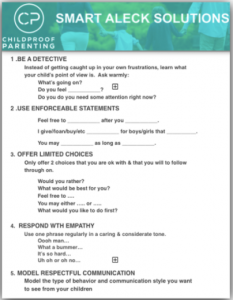
 

Need a cheat sheet to remember all this? Click here.


[irp posts=”2673″ name=”Helping Kids Navigate Playground Politics (by Melissa Benaroya)”]


About the Author: Melissa Benaroya

Melissa Benaroya, LICSW, is a Seattle-based parent coach, speaker and author in the Seattle area (MelissaBenaroya.com). She created the Childproof Parenting online course and is the co-founder of GROW Parenting and Mommy Matters. Melissa provides parents with the tools and support they need to raise healthy children and find more joy in parenting. Melissa offers parent coaching and classes and frequently speaks at area schools and businesses. Check out Melissa’s blog for more great tips on common parenting issues and Facebook for the latest news in parent education!

Leave a Reply

Your email address will not be published. Required fields are marked *


Join our newsletter

We would love you to follow us on Social Media to stay up to date with the latest Hey Sigmund news and upcoming events.

Follow Hey Sigmund on Instagram

‘Making sure they aren’t alone in it’ means making sure we, or another adult, helps them feel seen, safe, and cared as they move towards the brave, meaningful, growthful thing.❤️
Children will look to their closest adult - a parent, a teacher, a grandparent, an aunt, an uncle - for signs of safety and signs of danger.

What the parent believes, the child will follow, for better or worse.

Anxiety doesn’t mean they aren’t safe or capable. It means they don’t feel safe or capable enough yet.

As long as they are safe, this is where they need to borrow our calm and certainty until they can find their own. 

The questions to ask are, ‘Do I believe they are safe and cared for here?’ ‘Do I believe they are capable?’

It’s okay if your answer is no to either of these. We aren’t meant to feel safe handing our kiddos over to every situation or to any adult.

But if the answer is no, that’s where the work is.

What do you need to know they are safe and cared for? What changes need to be made? What can help you feel more certain? Is their discomfort from something unsafe or from something growthful? What needs to happen to know they are capable of this?

This can be so tricky for parents as it isn’t always clear. Are they anxious because this is new or because it’s unsafe?

As long as they are relationally safe (or have an adult working towards this) and their bodies feel safe, the work is to believe in them enough for them to believe it too - to handle our very understandable distress at their distress, make space for their distress, and show them we believe in them by what we do next: support avoidance or brave behaviour.

As long as they are safe, we don’t need to get rid of their anxiety or big feelings. Lovingly make space for those feelings AND brave behaviour. They can feel anxious and do brave. 

‘I know this feels big. Bring all your feelings to me. I can look after you through all of it. And yes, this is happening. I know you can do this. We’ll do it together.’

But we have to be kind and patient with ourselves too. The same instinct that makes you a wonderful parent - the attachment instinct - might send your ‘they’re not safe’ radar into overdrive. 

Talk to their adults at school, talk to them, get the info you need to feel certain enough, and trust they are safe, and capable enough, even when anxiety (theirs and yours) is saying no.❤️
Anxiety in kids is tough for everyone - kids and the adults who care about them.

It’s awful for them and confusing for us. Do we move them forward? Hold them back? Is this growing them? Hurting them?

As long as they are safe - as long as they feel cared for through it and their bodies feel okay - anxiety doesn’t mean something is wrong. 
It also doesn’t mean they aren’t capable.

It means there is a gap: ‘I want to, but I don’t know that I’ll be okay.’

As long as they are safe, they don’t need to avoid the situation. They need to keep going, with support, so they can gather the evidence they need. This might take time and lots of experiences.

The brain will always abandon the ‘I want to,’ in any situation that doesn’t have enough evidence - yet - that they’re safe.

Here’s the problem. If we support avoidance of safe situations, the brain doesn’t get the experience it needs to know the difference between hard, growthful things (like school, exams, driving tests, setting boundaries, job interviews, new friendships) and dangerous things. 

It takes time and lots of experience to be able to handle the discomfort of anxiety - and all hard, important, growthful things will come with anxiety.

The work for us isn’t to hold them back from safe situations (even though we’ll want to) but to help them feel supported through the anxiety.

This is part of helping them gather the evidence their brains and bodies need to know they can feel safe and do hard things, even when they are anxious.

Think of the space between comfortable (before the growthful thing) and ‘I’ve done the important, growthful thing,’ as ‘the brave space’. 

But it never feels brave. It feels like anxious, nervous, stressed, scared, awkward, clumsy. It’s all brave - because that’s what anxiety is. It’s handling the discomfort of the brave space while they inch toward the important thing.

Any experience in the brave space matters. Even if it’s just little steps at a time. Why? Because this is where they learn that they don’t need to be scared of anxiety when they’re heading towards something important. As long as they are safe, the anxiety of the brave space won’t hurt them. It will grow them.❤️
In the first few days or weeks of school, feelings might get big. This might happen before school (the anticipation) or after school (when their nervous systems reach capacity).

As long as they are safe (relationally, physiologically) their anxiety is normal and understandable and we don’t need to ‘fix’ it or rush them through it. 

They’re doing something big, something brave. Their brains and bodies will be searching for the familiar in the unfamiliar. They’re getting to know new routines, spaces, people. It’s a lot! Feeling safe in that might take time. But feeling safe and being safe are different. 

We don’t need to stop their anxiety or rush them through it. Our work is to help them move with it. Because when they feel anxious, and get safely through the other side of that anxiety, they learn something so important: they learn they can do hard things - even when they feel like they don’t have what it takes, they can do hard things. We know this about them already, but they’ll need experience in safe, caring environments, little by little, to know this for themselves.

Help them move through it by letting them know that all their feelings are safe with you, that their feelings make sense, and at the end of the day, let those feelings do what they need to. If they need to burst out of them like a little meteor shower, that’s okay. Maybe they’ll need to talk, or not, or cry, or get loud, or play, or be still, or messy for a while. That’s okay. It’s a nervous system at capacity looking for the release valve. It’s not a bad child. It’s never that. 

Tomorrow might be tricker, and the next day trickier, until their brains and bodies get enough experience that this is okay.

As long as they are safe, and they get there, it all counts. It’s all brave. It’s all enough.❤️
Anxiety on the first days or weeks of school is so normal. Why? Because all growthful, important, brave things come with anxiety.

Think about how you feel on their first day of school, or before a job interview, or a first date, or a tricky conversation when you’re setting a boundary. They all come with anxiety.

We want our kids to be able to do all of these things, but this won’t happen by itself. 

Resilience is built - one anxious little step after another. These anxious moments are necessary to learn that ‘I can feel anxious, and do brave.’ ‘I can feel anxious and still do what I need to do.’

As long as the are safe, the anxiety they feel in the first days or weeks of school aren’t a sign that something is wrong. It’s part of their development and a sign that something so right is happening - they’re learning that they can handle anxiety.

Even if they handle it terribly, that’s okay. We all wobble before we walk. Our job is not to protect them from the wobble. If we do, they won’t get to the walking part. 

To support them, remind them that this is scary-safe, not scary-dangerous. Then, ‘Is this a time for you to be safe or brave?’

Then, ask yourself, ‘Is this something dangerous or something growthful?’ ‘Is my job to protect them from the discomfort of that growth, or show them they are so very capable, and that they can handle this discomfort?’

Even if they handle it terribly, as long as they’re not avoiding it, they’re handling it. That matters.

Remember, anxiety is a feeling. It will come and then it will go. It might not go until you leave, but we have to give them the opportunity to feel it go.

Tomorrow and the next day and the next might be worse - that’s how anxiety works. And then it will ease.

This is why we don’t beat anxiety by avoiding it. We beat it by outlasting it. But first, we have to handle our distress at their distress.

We breathe, then we love and lead:

‘I know you feel […] Of course you do. You’re doing something big and this is how big things feel sometimes. It’s okay to feel like this. School is happening but we have five minutes. Do you want me to listen to your sad, or give you a hug, or help you distract from it?’❤️