


0 items | AUD  0.00

What If Your Family Went Screen-Free for a Week? Here’s How, And What It Could Do

What would happen if your family committed to just one week of going screen-free? Would you or your child experience panic, anxiety, unease, resentment?

Most parents and teens spend about nine hours a day in front of screens and agree that limiting their screen time to just school or work would be a major challenge. Eighty-three percent of the nine hours in front of screens typically has nothing to do with work or school and is spent texting, listening to music, watching shows and movies, playing video games, browsing websites, and using social media. 

Why try a screen-free week?

A healthy diet of moderate screen time can be helpful and educational and contribute to better mental well-being, but there are many drawbacks to overconsumption. Over consuming can literally lead to addiction, poor sleep, and unhealthy weight gain.

Addiction

Playing video games can release dopamine, the “feel good” hormone that is part of the brain’s reward and pleasure circuits. There is an American Psychiatric Association diagnosis given to people who are addicted to online gaming: impulse control disorder. The negative effects of this disorder can be both physical and emotional. It is generally characterized by social isolation, feeling restless or irritable, preoccupied with previous or upcoming games, fatigue, poor personal hygiene, and migraines from eyestrain. While the short-term effects include isolation and poor self-care, the long-term effects can lead to financial, academic, and occupational consequences.

Sleep Deprivation

Sleep hygiene is essential for all humans, but it is especially critical to the developing teen brain. The use of screens in the evening has been correlated with the decreased number of hours of sleep teens get and can make the process of falling asleep more challenging. Screens have this effect is because most of them emit a blue light that interferes with the body’s natural ability to release melatonin, a hormone that causes one to feel sleepy at night. This delayed release tends to throw off the body’s natural biological clock and circadian rhythms.

Weight Gain

It is no surprise that weight gain is also associated with the use of screens. There are several contributing factors that can lead to unhealthy weight. The most obvious reason for weight gain is the lack of physical activity when sitting in front of a screen. The lack of sleep when screens are overused can also affect our body’s ability to regulate weight. And last, unhealthy foods are often marketed on screens, as well, which leads to poor food choices. Some screen-free advocates will go as far as to say that sitting is the new smoking.

Steps to Starting Healthy Screen Consumption

  1. Identify screen-free time.

    The goal is not to eliminate all use of screens but to set limits on it. It can be easiest to do this when there are clearly defined windows of time when screens are not available for use. For some families, mornings are a time when screen use is prohibited because most teens are rushing out the door to make it to school on time. There has also been research showing that screen use can have a negative effect on executive functioning (memory and attention). Not a great way to start the day! The dinner table and time in the car are also great opportunities to limit screen use. With the busy lives that teens lead these days, parents now have limited opportunities to connect with their children. These windows of time can be made sacred by setting hard limits on making them screen-free zones.

  2. Get busy.

    When kids are busy outdoors or engaged in extracurricular activities, they get the bonus of face-to-face communication. The American Academy of Pediatrics suggests that all kids get at least 60 minutes of activity a day. Explore their interests and get them signed up for weekly activities that reflect their interests.

  3. Turn it off.

    Set a deadline for when screens and technology get turned off. This can take the form of turning off a Wi-Fi router at a certain time each night or collecting phones, iPads, and computers to be charged in a place that is not visible. Your child’s health, development, and well-being are dependent on sleep. Encouraging healthy sleep habits sets your teen up for success in all aspects of their lives.

  4. Be a role model.

    Don’t think for a second that your child will alter their behavior if you aren’t making changes to the way you use screens. We cannot expect our children to regulate their screen use if we are not able to do so ourselves. Be mindful that the expectations you set for your child should be adhered to by everyone in the family.

  5. Be a partner.

    When approaching the subject of weaning your family from screens, make sure you take a collaborative approach. By developing these policies and rules together, you will have greater buy-in, and your teen will be more likely to adhere. When you are forming the policies, be clear that they apply to everyone in the family and that everyone is accountable. This approach often feels more respectful and collaborative, which will encourage your child to cooperate in the effort.

The use of screens and technology is inevitable in all of our lives. As parents, we need to be responsible users and help our teens to do the same. It takes some time and patience to make these changes, but they pay off by making parenting a whole lot easier, allowing more opportunities for connection with your child, and ensuring your child has the greatest opportunity to learn and grow.

Would you like to have your own Device Use Contract to make sure you are covering all your bases? 
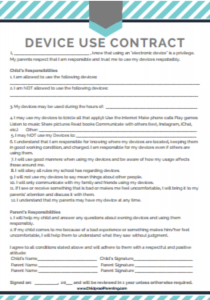
Device Use Contract

 This article was originally written for The Committee For Children Blog.


About the Author: Melissa Benaroya


Melissa Benaroya, LICSW, is a Seattle-based parent coach, speaker and author in the Seattle area (MelissaBenaroya.com). She created the Childproof Parenting online course and is the co-founder of GROW Parenting and Mommy Matters, and the co-author of The Childproof Parent. Melissa provides parents with the tools and support they need to raise healthy children and find more joy in parenting. Melissa offers parent coaching and classes and frequently speaks at area schools and businesses. Check out Melissa’s blog for more great tips on common parenting issues and Facebook for the latest news in parent education.

Leave a Reply

Your email address will not be published. Required fields are marked *


Join our newsletter

We would love you to follow us on Social Media to stay up to date with the latest Hey Sigmund news and upcoming events.

Follow Hey Sigmund on Instagram

Children will look to their closest adult - a parent, a teacher, a grandparent, an aunt, an uncle - for signs of safety and signs of danger.

What the parent believes, the child will follow, for better or worse.

Anxiety doesn’t mean they aren’t safe or capable. It means they don’t feel safe or capable enough yet.

As long as they are safe, this is where they need to borrow our calm and certainty until they can find their own. 

The questions to ask are, ‘Do I believe they are safe and cared for here?’ ‘Do I believe they are capable?’

It’s okay if your answer is no to either of these. We aren’t meant to feel safe handing our kiddos over to every situation or to any adult.

But if the answer is no, that’s where the work is.

What do you need to know they are safe and cared for? What changes need to be made? What can help you feel more certain? Is their discomfort from something unsafe or from something growthful? What needs to happen to know they are capable of this?

This can be so tricky for parents as it isn’t always clear. Are they anxious because this is new or because it’s unsafe?

As long as they are relationally safe (or have an adult working towards this) and their bodies feel safe, the work is to believe in them enough for them to believe it too - to handle our very understandable distress at their distress, make space for their distress, and show them we believe in them by what we do next: support avoidance or brave behaviour.

As long as they are safe, we don’t need to get rid of their anxiety or big feelings. Lovingly make space for those feelings AND brave behaviour. They can feel anxious and do brave. 

‘I know this feels big. Bring all your feelings to me. I can look after you through all of it. And yes, this is happening. I know you can do this. We’ll do it together.’

But we have to be kind and patient with ourselves too. The same instinct that makes you a wonderful parent - the attachment instinct - might send your ‘they’re not safe’ radar into overdrive. 

Talk to their adults at school, talk to them, get the info you need to feel certain enough, and trust they are safe, and capable enough, even when anxiety (theirs and yours) is saying no.❤️
Anxiety in kids is tough for everyone - kids and the adults who care about them.

It’s awful for them and confusing for us. Do we move them forward? Hold them back? Is this growing them? Hurting them?

As long as they are safe - as long as they feel cared for through it and their bodies feel okay - anxiety doesn’t mean something is wrong. 
It also doesn’t mean they aren’t capable.

It means there is a gap: ‘I want to, but I don’t know that I’ll be okay.’

As long as they are safe, they don’t need to avoid the situation. They need to keep going, with support, so they can gather the evidence they need. This might take time and lots of experiences.

The brain will always abandon the ‘I want to,’ in any situation that doesn’t have enough evidence - yet - that they’re safe.

Here’s the problem. If we support avoidance of safe situations, the brain doesn’t get the experience it needs to know the difference between hard, growthful things (like school, exams, driving tests, setting boundaries, job interviews, new friendships) and dangerous things. 

It takes time and lots of experience to be able to handle the discomfort of anxiety - and all hard, important, growthful things will come with anxiety.

The work for us isn’t to hold them back from safe situations (even though we’ll want to) but to help them feel supported through the anxiety.

This is part of helping them gather the evidence their brains and bodies need to know they can feel safe and do hard things, even when they are anxious.

Think of the space between comfortable (before the growthful thing) and ‘I’ve done the important, growthful thing,’ as ‘the brave space’. 

But it never feels brave. It feels like anxious, nervous, stressed, scared, awkward, clumsy. It’s all brave - because that’s what anxiety is. It’s handling the discomfort of the brave space while they inch toward the important thing.

Any experience in the brave space matters. Even if it’s just little steps at a time. Why? Because this is where they learn that they don’t need to be scared of anxiety when they’re heading towards something important. As long as they are safe, the anxiety of the brave space won’t hurt them. It will grow them.❤️
In the first few days or weeks of school, feelings might get big. This might happen before school (the anticipation) or after school (when their nervous systems reach capacity).

As long as they are safe (relationally, physiologically) their anxiety is normal and understandable and we don’t need to ‘fix’ it or rush them through it. 

They’re doing something big, something brave. Their brains and bodies will be searching for the familiar in the unfamiliar. They’re getting to know new routines, spaces, people. It’s a lot! Feeling safe in that might take time. But feeling safe and being safe are different. 

We don’t need to stop their anxiety or rush them through it. Our work is to help them move with it. Because when they feel anxious, and get safely through the other side of that anxiety, they learn something so important: they learn they can do hard things - even when they feel like they don’t have what it takes, they can do hard things. We know this about them already, but they’ll need experience in safe, caring environments, little by little, to know this for themselves.

Help them move through it by letting them know that all their feelings are safe with you, that their feelings make sense, and at the end of the day, let those feelings do what they need to. If they need to burst out of them like a little meteor shower, that’s okay. Maybe they’ll need to talk, or not, or cry, or get loud, or play, or be still, or messy for a while. That’s okay. It’s a nervous system at capacity looking for the release valve. It’s not a bad child. It’s never that. 

Tomorrow might be tricker, and the next day trickier, until their brains and bodies get enough experience that this is okay.

As long as they are safe, and they get there, it all counts. It’s all brave. It’s all enough.❤️
Anxiety on the first days or weeks of school is so normal. Why? Because all growthful, important, brave things come with anxiety.

Think about how you feel on their first day of school, or before a job interview, or a first date, or a tricky conversation when you’re setting a boundary. They all come with anxiety.

We want our kids to be able to do all of these things, but this won’t happen by itself. 

Resilience is built - one anxious little step after another. These anxious moments are necessary to learn that ‘I can feel anxious, and do brave.’ ‘I can feel anxious and still do what I need to do.’

As long as the are safe, the anxiety they feel in the first days or weeks of school aren’t a sign that something is wrong. It’s part of their development and a sign that something so right is happening - they’re learning that they can handle anxiety.

Even if they handle it terribly, that’s okay. We all wobble before we walk. Our job is not to protect them from the wobble. If we do, they won’t get to the walking part. 

To support them, remind them that this is scary-safe, not scary-dangerous. Then, ‘Is this a time for you to be safe or brave?’

Then, ask yourself, ‘Is this something dangerous or something growthful?’ ‘Is my job to protect them from the discomfort of that growth, or show them they are so very capable, and that they can handle this discomfort?’

Even if they handle it terribly, as long as they’re not avoiding it, they’re handling it. That matters.

Remember, anxiety is a feeling. It will come and then it will go. It might not go until you leave, but we have to give them the opportunity to feel it go.

Tomorrow and the next day and the next might be worse - that’s how anxiety works. And then it will ease.

This is why we don’t beat anxiety by avoiding it. We beat it by outlasting it. But first, we have to handle our distress at their distress.

We breathe, then we love and lead:

‘I know you feel […] Of course you do. You’re doing something big and this is how big things feel sometimes. It’s okay to feel like this. School is happening but we have five minutes. Do you want me to listen to your sad, or give you a hug, or help you distract from it?’❤️