


Anxiety is a normal response to something dangerous or stressful. It becomes a problem when it shows up at unexpected times and takes a particularly firm hold. When anxiety is in full swing, it feels awful. Awful enough that anticipation of the feeling is enough in itself to cause anxiety. Anxiety in kids can be especially confusing , not only for the ones who are feeling anxious, but also for the adults who care about them.
We already know that anxiety has nothing to do with strength, courage or character. It picks a target and it switches on.
When that target is a child or teen, it can be particularly distressing, causing problems with sleeping, eating and missed school from unexplained illnesses such as sick tummies or headaches.
One of the worst things about anxiety in kids is the way it can happen without any identifiable cause. The physical feeling is familiar – that panicked feeling that comes when you miss a stair or as my daughter recently described, ‘that feeling you get when you’re almost asleep and you feel like you’re falling.’ (‘Yes, we’ve dealt with it in our home too. It’s under control now, so I can assure you this works.)
The good news is that anxiety in kids is very treatable and they are particularly responsive. I often think we don’t give them enough credit. They’re so open to possibility, and very quick to make the right connections when they’re given the right information and support. As the adult in their lives, you’re the perfect one to give it.
Anxiety in Kids and Teens: Turning it Around
-
Don’t talk them out of it.
As a parent, the temptation is to reassure your child with gentle comments in the way of, ‘There’s nothing to worry about,’ or ‘You’ll be fine‘.
This comes from the purest of intentions but it runs the risk of them feeling as though there’s something wrong with them. The truth is that when anxiety has a hold of them, they can no sooner stop worrying than fly to the moon. As much as they want to believe you, their brains just won’t let them.
What they need to hear is that you get it. Ask them what it feels like for them. They may or may not be able to articulate – and that’s okay. Then, ask if it’s ‘like that feeling you get when you miss a stair,’ (or ‘that feeling you get when you feel like you’re falling in your sleep’). Often, this in itself is such a relief because ‘someone gets it.’
-
Normalise.
Explain that:
•. Anxiety is normal and everyone experiences anxiety at some time in their life – before an exam, when meeting new people, going for an interview or starting at a new school.
• Sometimes it happens for no reason at all. That’s also normal. It happens to lots of adults and lots of kids but there are things you can do to make it go away.
-
Explain why anxiety feels like it does.
Out of everything, this is perhaps the most powerful intervention for anyone with anxiety. Anxiety in kids causes the most problems when it seems to come on without any real trigger. There’s a reason for this, and understanding the reason is key to managing the anxiety.
Here is a child-friendly explanation. I’ve used it for a variety of ages, but nobody knows your child like you do so adjust it to suit.
‘Anxiety is something that lots of people get but it feels different for everyone. Anxiety in kids is common, and lots of adults get it too. It happens because there’s a part of your brain that thinks there’s something it needs to protect you from. The part of the brain is called the amygdala. It’s not very big and it’s shaped like an almond.
It switches on when it thinks you’re in danger, so really it’s like your own fierce warrior, there to protect you. It’s job is to get you ready to run away from the danger or fight it. People call this ‘fight or flight’.
If your amygdala thinks there’s trouble, it will immediately give your body what it needs to be strong, fast and powerful. It will flood your body with oxygen, hormones and adrenaline that your body can use as fuel to power your muscles to run away or fight. It does this without even thinking. This happens so quickly and so automatically. The amygdala doesn’t take time to check anything out. It’s a doer not a thinker – all action and not a lot of thought.
If there is something dangerous – a wild dog you need to run away from, a fall you need to steady yourself from – then the amygdala is brilliant. Sometimes though, the amygdala thinks there’s a threat and fuels you up even though there’s actually nothing dangerous there at all.
Have you ever made toast that has got a bit burnt and set off the fire alarm? The fire alarm can’t tell the difference between smoke from a fire and smoke from burnt toast – and it doesn’t care. All it wants to do is let you know so you can get out of there. The amygdala works the same way. It can’t tell the difference between something that might hurt you, like a wild dog, and something that won’t, like being at a new school. Sometimes the amygdala just switches on before you even know what it’s switching on for. It’s always working hard to protect you – even when you don’t need protecting. It’s a doer not a thinker, remember, and this is how it keeps you safe.
If you don’t need to run away or fight for your life, there’s nothing to burn all that fuel – the oxygen, hormones and adrenalin – that the amygdala has flooded you with. It builds up and that’s the reason you feel like you do when you have anxiety. It’s like if you just keep pouring petrol into a car and never take the car for a drive.
So when the amygdala senses a threat it floods your body with oxygen, adrenaline and hormones that your body can use to fuel its fight or flight. When this happens:
♦ Your breathing changes from normal slow deep breaths to fast little breaths. Your body does this because your brain has told it to stop using up the oxygen for strong breaths and send it to the muscles to they can run or fight.
When this happens you might feel puffed or a bit breathless. You also might feel the blood rush to your face and your face become warm.
♦ If you don’t fight or flee, the oxygen builds up and the carbon dioxide drops.
This can make you feel dizzy or a bit confused.
♦ Your heart beats faster to get the oxygen around the body.
Your heart can feel like it’s racing and you might feel sick.
♦ Fuel gets sent to your arms (in case they need to fight) and your legs (in case they need to flee).
Your arms and legs might tense up or your muscles might feel tight.
♦ Your body cools itself down (by sweating) so it doesn’t overheat if it has to fight or flee
You might feel a bit sweaty.
♦ Your digestive system – the part of the body that gets the nutrients from the food you eat – shuts down so that the fuel it was using to digest your food can be used by your arms and legs in case you have to fight or flee. (Don’t worry though – it won’t stay shut down for long.)
You might feel like you have butterflies in your tummy. You might also feel sick, as though you’re going to vomit, and your mouth might feel a bit dry.
As you can see, there are very real reasons for your body feeling the way it does when you have anxiety. It’s all because your amygdala – that fierce warrior part of your brain – is trying to protect you by getting your body ready to fight or flee. Problem is – there’s nothing to fight or flee. Don’t worry though, there are things we can do about this.’
-
Explain how common anxiety in kids is.
Anxiety in kids is common. About 1 in 8 kids have struggled with anxiety – so let them know that in their class, there’s a good chance that 3 or 4 other kids would know exactly what they’re going through because they’ve been through it before. Maybe they’re going through it right now.
-
Give it a name.
‘Now that you understand that your anxiety feelings come from the ‘heroic warrior’ part of your brain, let’s give it a name.’ Let your child pick the name and ask them what they think of when they picture it. This will help them to feel as though something else is the problem, not them. It also demystifies their anxiety. Rather than it being a nameless, faceless ‘thing’ that gets in their way, it’s something contained – with a name and a look.
-
Now get them into position.
‘The problem with anxiety is that [whatever their ‘heroic warrior’ is called – for the moment, let’s say, ‘Zep’] Zep is calling all the shots but we know that you’re really the boss. Zep actually thinks it’s protecting you, so what you need to do is let it know that you’ve got this and that it can relax. When you get those anxious feelings, that means Zep is taking over and getting ready to keep you safe. It doesn’t think about it at all – it just jumps in and goes for it. What you need to do is to let it know that you’re okay.
The most powerful thing you can do to make yourself the boss of your brain again is breathe. It sounds so simple – and it is. Part of the reason you feel as you do is because your breathing has gone from strong and slow and deep to quick and shallow. That type of breathing changes the balance of oxygen and carbon dioxide in your body. Once your breathing is under control, Zep will stop thinking he has to protect you and he’ll settle back down. Then, really quickly after that, you’ll stop feeling the way you do.’
-
And breathe.
Breathe deeply and slowly. Hold your breath just for a second between breathing in and breathing out. Make sure the breath is going right down into your belly – not just into your chest. You can tell because your belly will be moving. Do this about 5 to 10 times.
Practice before bed every day. Remember that Zep, the warrior part of your brain, has been protecting you for your entire life so it might take a little bit of practice to convince Zep to relax. But keep practicing and you’ll be really good at it in no time. You and that warrior part of your brain will be buddies – but with you in control.One way to practice is by putting a soft toy on your child’s belly when they lie down. If the toy is moving up and down, their breathing is perfect.
-
Practice mindfulness.
An abundance of scientific research has demonstrated the profound effects of mindfulness. MRI studies have shown that practicing mindfulness increases the density of gray matter in the brain, providing relief and protection from stress, anxiety and depression. See here for more information.
Mindfulness doesn’t have to be complicated. Essentially, it’s being aware of the present moment, and there are plenty of fun ways introduce children to mindfulness.
Start by explaining that anxiety comes about because of worry about the future and what might happen. Sometimes these thoughts happen in the background – we don’t even know they’re there. Mindfulness helps you to have control over your brain so you can stop it from worrying about things it doesn’t need to. It trains your brain to stay in the here and now. The brain is like a muscle and the more you exercise it the stronger it gets.
It sounds easy enough but minds quite like to wander so staying in the moment can take some practice. Here’s the how:
- Close your eyes and notice your breathing. How does the air feel as you draw it inside you? Notice the sensation of the air, or your belly rising and falling. Notice your heart beating. If your mind starts to wander, come back to this.
- Now, what can you hear? What can you feel outside of you and inside your body? If your mind starts to wander, focus on your breathing again.
Remember that anxiety in kids is very treatable but it might take time. Explain to your child that his or her very clever and very protective brain might need some convincing that just because it thinks there’s trouble coming, doesn’t mean there is. Keep practising and they’ll get there.
 A Book for Kids About Anxiety …
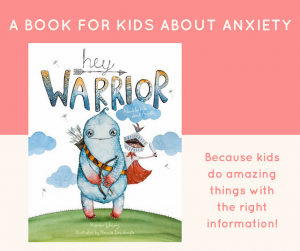
‘Hey Warrior’ is a book for children to help them understand anxiety and to find their ‘brave’. It explains why anxiety feels the way it does, and it will teach them how they can ‘be the boss of their brain’ during anxiety, to feel calm. It’s not always enough to tell kids what to do – they need to understand why it works. Hey Warrior does this, giving explanations in a fun, simple, way that helps things make sense in a, ‘Oh so that’s how that works!’ kind of way, alongside gorgeous illustrations. (See here for the trailer.)



Leave a Reply