
Anxiety is such a human experience. Anyone who has stretched themselves far enough to do something brave would have scraped against it in some way. If anxiety could, it would throw its wild warrior arms around us, smother us with kisses and tell us it was there to keep us safe by warning us of danger and getting us ready to deal with it. Too often though, that ‘danger’ is more a challenge than a threat, and what we need is not to be held back from it, but for anxiety to step aside so we can move boldly through the middle of it.
Groundbreaking research from Amy Cuddy at Harvard has found a way to make this happen and to feel more empowered, confident and to have greater influence – and it only takes a couple of minutes. By striking a ‘power pose’ and holding it for two minutes, anyone can feel more like boss of the world, even on those days when feeling boss of your toothbrush is a stretch. And we’ve all had them.
We tend to be steered by our thoughts and our feelings, but our actions can have enormous influence over the way we feel and the way we are seen. It all has to do with the mind-body connection. We know that our minds have a spectacular capacity to influence what we feel in our body. Anxiety is one example of this. If our brain tells us there’s something to worry about, our body instantly feels the full effect – a racy heart, clammy skin, butterflies, dry mouth, sick, tense, wobbly. One thing that can be said about anxiety is that it’s thorough, even if a little misguided at times.
The mind-body connection also works the other way. What we do with our body has the capacity to influence how we feel, which affects our behaviour, which in turn changes the way we are seen. What this means its that we all have a profound capacity to influence how we are perceived by others.
Feel less anxious, more confident? Tell me how.
Striking a power pose for two minutes will change the brain in ways that will reduce anxiety and build confidence and assertiveness. This, in turn, will change the way others experience you. The pose can be done in private. It’s not important that other people see the power pose in full flight, as glorious as that is likely to be. What’s important are the physiological changes that are triggered by the pose. These are what will have the effect on the way you actually feel, which will in turn have an effect on the way you are seen.
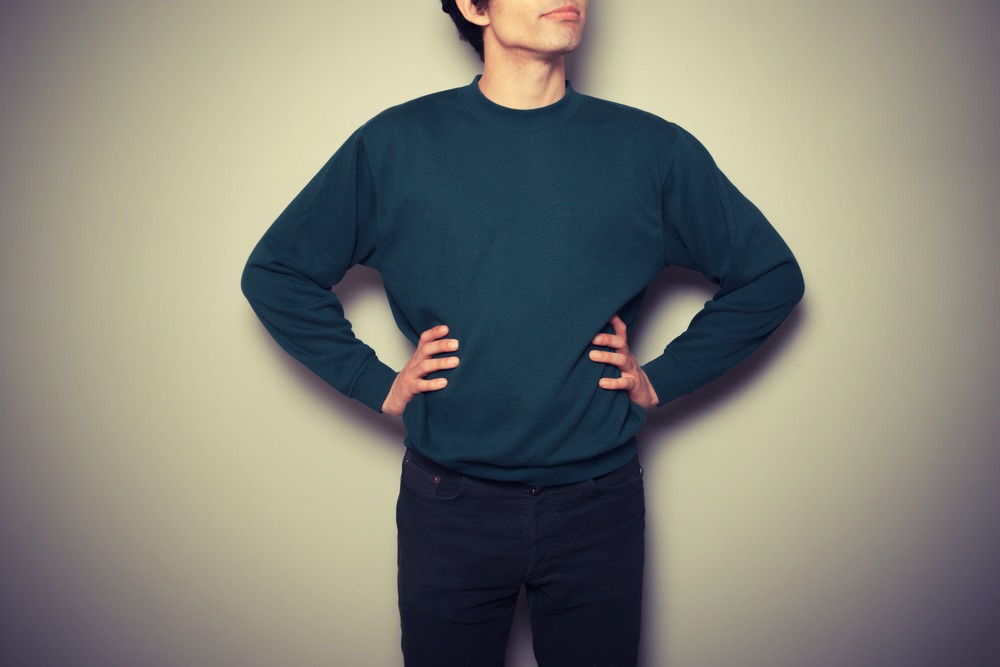
Any pose that increases the space your body occupies is a power pose. Think Superman with legs wide apart, hands stretched out in front, chin up, chest out. Alternatively, channelling Wonder Woman – legs apart, hands on hips, shoulders back and chest – will also have the same effect. Ditto for a starfish pose – arms and legs outstretched and wide apart. In short, a power pose is anything that makes your physical presence bigger.
We make our minds up about people in seconds. Though these impressions are never a definitive guide to the other, we are very quick to pick up signals relating to warmth, approachability, confidence and influence. There are evolutionary reasons for this – we need to be able to figure out quickly if the person in front of us is more likely to be a lover or a hater. To make these judgements, we look at a host of non-verbal signs including posture, facial expressions, and general physical presence.
Striking a power pose for two minutes will effect those non-verbals in a positive, powerful way. When our body is allowed to feel powerful for a couple of minutes, our mind will listen and will project this image forward.
Convince me. What’s the evidence?
The research on this was conducted at Harvard by Amy Cuddy and colleagues, and the results have profound implications for all of us. The study found that when people held certain poses, there were measurable changes in the levels of testosterone (the dominance hormone) and cortisol (the stress hormone). Specifically, when people expanded themselves into a high power pose for two minutes, they experienced a 20% increase in testosterone and a 25% decrease in cortisol. Higher testosterone leads to greater confidence, while lower cortisol leads to an increased capacity to deal with stress. It’s a powerful combination.
On the other hand, low-power poses, which is any poses that diminishes or shrinks physical presence, lead to a 10% decrease in testosterone and a 15% increase in cortisol. This means less power and higher stress. Any pose that diminishes the physical presence will have the effect of increasing stress levels and lowering confidence, causing you to be seen as less influential, less confident and more anxious. Low-power poses include hunching, folding the arms, crossing the knees and ankles tightly while sitting, or touching the face or neck.
The beautiful thing about power posing is that it can be done anywhere at any time. It can be used to full effect before a job interview, a date, an exam, against the bullies, negotiating the price of a car, before a presentation, when you want schoolbags dropped somewhere other than the doorway, when you want to say ‘no’ but feel like you’re going to say ‘ahhh not sure … maybe … okay … love to … absolutely’, or any situation that feeling more powerful and more confident will boost you.
Remember, the pose doesn’t have to be visible to your audience – that’s the brilliant thing about it. You might not want to ‘Wonder Woman’ it in the middle of a job interview, but taking time before-hand will make a difference to your physiology, the way you feel and the way you are seen.
Our minds can tend to have a mind of their own and when they do, they can be persuasive. They can undermine confidence and influence the way we are seen by others. Regardless of how we feel or what we think, expanding ourselves physically by way of a two-minute power pose, is a proven and powerful way to be more present, more confident, more assertive and more influential.



LOVE THIS! ❤️ Thank you for this wonderful article and for the empowering and positive influence your organization puts out into the world! We need it.
My mother is a covert narcissist and has completely turned our family upside down since she moved here and actually since we were younger but she looks like Martha Stewart however my husband was brutally attacked as a child and has been going in and out and on and off the medication and is 60 they are looking for a therapist that specializes and digging deep what they called naturalization therapy what do you think of this type of therapy
Wendy I’m sorry this is happening to your family. One person can do so much damage can’t they. Naturalization therapy isn’t a type of therapy I’m familiar with, so I’m not able to comment on that with any authority. I hope your parents are able to find the support they need.
Sounds good. I’m going to try this and see if it works for me. Thank you.❤️
I listened to a programme about this very subject on BBC Radio 4, Women’s Hours recently. I have been striking up my Wonder Woman pose every day since and it really does help me feel better and more significant.