

Knowledge is power. When children understand what’s happening in the brain, it can be the first step to having the power to make choices. Knowledge can be equally powerful to parents too. Knowing how the brain works means we can also understand how to respond when our children need our help.
Sometimes our brains can become overwhelmed with feelings of fear, sadness or anger, and when this happens, it’s confusing – especially to children. So giving children ways to make sense of what’s happening in their brain is important. It’s also helpful for children to have a vocabulary for their emotional experiences that others can understand. Think of it like a foreign language; if the other people in your family speak that language too, then it’s easier to communicate with them.
So how do you start these conversations with your children, make it playful enough to keep them engaged, and simple enough for them to understand?
Here is how I teach children (and parents) how to understand the brain.
Introducing the brain house: the upstairs and the downstairs
I tell children that their brains are like a house, with an upstairs and a downstairs. This idea comes from Dr Dan Siegel and Tina Payne Bryson’s book ‘The Whole Brain Child’, and it’s a really simple way to help kids to think about what’s going on inside their head. I’ve taken this analogy one step further by talking about who lives in the house. I tell them stories about the characters who live upstairs, and the ones who live downstairs. Really, what I’m talking about are the functions of the neocortex (our thinking brain – the upstairs), and the limbic system (our feeling brain – the downstairs).
Who lives upstairs and who lives downstairs.
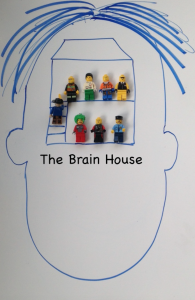
‘The Brain House’
Typically, the upstairs characters are thinkers, problem solvers, planners, emotion regulators, creatives, flexible and empathic types. I give them names like Calming Carl, Problem Solving Pete, Creative Craig and Flexible Felix
The downstairs folk are the feelers. They are very focused on keeping us safe and making sure our needs are met. Our instinct for survival originates here. These characters look out for danger, sound the alarm and make sure we are ready to fight, run or hide when we are faced with a threat. Downstairs we’ve got characters like Alerting Allie, Frightened Fred, and Big Boss Bootsy.
It doesn’t really matter what you call them, as long as you and your child know who (and what) you are talking about. You could have a go at coming up with your own names: try boys/girls names, animal names, cartoon names or completely make-up names. You might like to find characters from films or books they love, to find your unique shared language for these brain functions.
Flipping our lids: When ‘downstairs’ takes over.
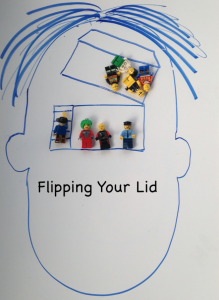
‘The Brain House: Flipping Your Lid’
Our brains work best when the upstairs and the downstairs work together. Imagine that the stairs connecting upstairs and downstairs are very busy with characters carrying messages up and down to each other. This is what helps us make good choices, make friends and get along with other people, come up with exciting games to play, calm ourselves down and get ourselves out of sticky situations.
Sometimes, in the downstairs brain, Alerting Allie spots some danger, Frightened Fred panics and before we know where we are, Big Boss Bootsy has sounded the alarm telling your body to be prepared for danger. Big Boss Bootsy is a bossy fellow, and he shouts ‘the downstairs brain is taking over now. Upstairs gang can work properly again when we are out of danger’. The downstairs brain “flips the lid” (to borrow Dan Siegel’s phrase) on the upstairs brain. This means that the stairs that normally allow the upstairs and downstairs to work together are no longer connected.
Sometimes, flipping our lids is the safest thing to do.
When everybody in the brain house is making noise, it’s hard for anyone to be heard. Bootsy is keeping the upstairs brain quiet so the downstairs folk can get our body ready for the danger. Boots can signal other parts of our body that need to switch on (or off). He can make our heart beat faster so we are ready to run very fast, or our muscles ready to fight as hard as we can. He can also tell parts of our body to stay very very still so we can hide from the danger. Bootsy is doing this to keep us safe.
Try asking your child to imagine when these reactions would be safest. I often try to use examples that wouldn’t actually happen (again so that children can imagine these ideas in a playful way without becoming too frightened by them). For example, what would your downstairs brain do if you met a dinosaur in the playground?
Everyone flips their lids.
Think of some examples to share with your child about how we can all flip our lids. Choose examples that aren’t too stressful because if you make your kids feel too anxious they may flip their lids then and there!
Here’s an example I might use: Remember when Mummy couldn’t find the car keys and we were already late for school. Remember how I kept looking in the same place over and over again. That’s because the downstairs brain had taken over, I had flipped my lid and the upstairs, thinking part of my brain, wasn’t working properly.
When the downstairs brain gets it wrong.
There might be times when we flips our lids but really we still need the upstairs gang like Problem Solving Pete, and Calming Carl to help us.
We all flip our lids, but often children flip their lids more than adults. In children’s brains, Big Boss Bootsy can get a bit over excited and press the panic button to trigger meltdowns and tantrums over very small things and that’s because the upstairs part of your child’s brain is still being built. In fact, it won’t be finished being built until the mid twenties. Sometimes, when I want to emphasise this point, I ask kids this question:
Have you ever seen your Dad or Mum lay on the floor in the supermarket screaming that they want chocolate buttons?
They often giggle, and giggling is good because it means it’s still playful, so they are still engaged and learning. I tell them parents actually like chocolate just as much as children, but adults have practiced getting Calming Carl and Problem Solving Pete to work with Big Boss Bootsy and can (sometimes) stop him from sounding the danger alarm when he doesn’t need to. It does take practice and I remind children that their brains are still building and learning from experience.
From a shared language to emotional regulation
Once you’ve got all the characters in the brain house, you have a shared language that you can use to help your child learn how to regulate (manage) their emotions. For example, ‘it looks like Big Boss Bootsy might be getting ready to sound the alarm, how about seeing if Calming Carl can send a message saying ‘take some deep breaths’ ’’ .
The language of the brain house also allows kids to talk more freely about their own mistakes, it’s non judgemental, playful and can be talked about as being separate (psychologists also call this ‘externalised’) from them. Imagine how hard it might be to say ‘I hit Jenny today at school’ versus ‘Big Boss Bootsy really flipped the lid today’. When I say this to parents, some worry that I’m giving children a ‘get out clause’ – ‘can’t they just blame Bootsy for their misbehaviour?’. Ultimately what this is about is enabling children to learn functional ways to manage big feelings, and some of that will happen from conversations about the things that went wrong. If children feel able to talk about their mistakes with you, then you have an opportunity to join your upstairs brain folk with theirs, and problem solve together. It doesn’t mean they escape consequences or shirk responsibility. It means you can ask questions like ‘do you think there is anything you could do to help Bootsy keep the lid on?’.
Knowing about the brain house also helps parents to think about how to respond when their child is flooded with fear, anger or sadness. Have you ever told you child to ‘calm down’ when they have flipped their lid? I have. Yet what we know about the brain house is Calming Carl lives upstairs and when Bootsy’s flipped the lid, Calming Carl can’t do much to help until the lid is back on. Your child may have gone beyond the point where they can help themselves to calm down. Sometimes, parents (teachers or carers) have to help kids to get their lids back on, and we can do this with empathy, patience and often taking a great deal of deep breaths ourselves!
Where to go from here?
Don’t expect to move all the characters into the brain house and unpack on the same day; moving house takes time, and so does learning about brains. Start the conversation and revisit it. You might want to find creative ways to explore the brain house with your child. Here are a few ideas to get you started:
- draw the brain house and all the characters
- draw a picture of what it looks like in the house when the downstairs flips their lid
- find a comic, cut out and stick characters into the downstairs and the upstairs
- write stories about the adventures of the characters in the brain house
- use a doll’s house (or if you don’t have a dolls house, two shoe boxes, one on top of the other works just as well) and fill it with the downstairs and upstairs characters.
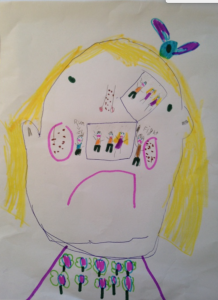
‘The Brain House’ by Sophie, Age 8
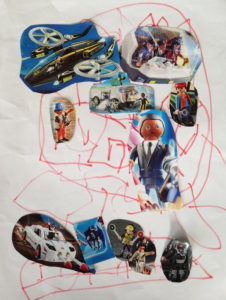
‘The Brain House’ by Jacob, Age 5
If you find other creative ways to explore the brain house, I would love to hear about them. Make it fun, make it lively and kids won’t even realise they are learning the foundations of emotional intelligence.
About the Author: Dr Hazel Harrison
Dr Hazel Harrison works as a clinical psychologist in the United Kingdom. She founded ThinkAvellana to bring psychology out of the clinic and into everyday life. Her website is www.thinkavellana.com and you can also follow her on Twitter at @thinkavellana and on Facebook at www.facebook.com/thinkavellana



Dear Karen, I enjoy yours: how to teach kids about the brain! but I was expecting for you to talk about the neuron etc. I am not sure what´s the age range you are considering? Say those 4-6 years olds?
I will send you an article how children represent what is inside their heads! My question: how to talk about the structure & function of the brain to kids?
I am an Associate Professor of Neurophysiology & Educational Neuroscience at the University of Paraná, Brazil
Here is an article that might help https://www.heysigmund.com/dear-kids-love-from-your-brain-what-all-kids-need-to-know-about-the-brain/.
Brilliant article!! A fantastic way of helping children understand how their minds work.
Very helpful article ,I like imagination , I created our own character in Arabic
I really LOVE this article and I have incorporated teaching about the brain house into my clinical practice with children and adolescents. It has been very helpful for many young people and parents alike!
I am also an author of therapeutic children’s books (When Monkey Lost His Smile and Sam’s Big Secret: Coping with fear) and this article has truly inspired me!
Thank you so much for sharing this wonderful work.
I just love this article. So helpful both personally and professionally. I use it a lot in my work as coach with leaders and teams.
Love this article – it’s so concise & the activities sound like great deas! I like to teach kids about the amygdala specifically & I once heart another clinician call “her” Amy G. Dala & my clients love it!
Have your tried with teens eg 14-16 years? How would you do it differenttly for teens?
Teens are absolutely receptive to this information. During adolescence, their brains go through massive changes, and understanding these changes can help them to make sense of the different and sometimes confusing things they will go through during adolescence. Here is an article that will help you to explain these changes https://www.heysigmund.com/the-adolescent-brain-what-they-need-to-know/
Teaching adults jow to teach children is great and this read is such a great help at that. But more importantly, it helped me understand the whole concept so much better- thank you
This is a great idea but I’m not very creative when it comes to stories. It would be great as a series of short stories. I’ve found that there are lots of books that are really good like Jack feels big but it doesn’t explain what’s going on in the brain but has lead to lots of discussion and crafty projects. Definitely a niche in the market.
Hi I used the brain house using a dolls house with my nurture group and it was very successful. I’m shortly doing a ‘brain day’ for parents and children and would like a carousel of activities to show and explain what goes on up there! Any ideas would be very grateful
Pam it’s so great that you’re doing this! Here is an article on anger that might give you an idea of something else to do https://www.heysigmund.com/raising-kids-emotionally-intelligent-kids-teens-anger-how-to-be-the-boss-of-your-brain/. Hope it helps.
Thanks from me too. I teach children and teachers and this is such a wonderful vivid way to explain emotional meltdowns.
Hazel, I have just discovered this and think it will be brilliant for me to share with the practitioners I train, who work with children, young people and families. They already have a lot of knowledge on brain development but this is such a simple and safe way to explain to parents and children alike.
I will also share it with my colleagues who work with looked after children too. thank you
Thanks Jill. I agree that findings safe ways to share these ideas is so important.
Thanks for this fantastic article!
As an elementary teacher and lifelong learner, I see a great benefit to your approach in making sense of how our brain works, using humour and play to get the message across.
Many helpful recommendations have been made by your readers, and I wanted to add to the list as a way of giving back too.
There is a series of 5 videos from Class Dojo about Growth Mindset and how the brain is a muscle that needs to be exercised which sounds very much in line with the recommendation “Your fantastic elastic brain”. My students loved them, and they refer back to them when someone is ready to give up.
Here’s the link: https://www.classdojo.com/BigIdeas/
Best wishes with all that you do Hazel!
I also agree with Elizabeth, maybe a children’s book in the works for you?
Cheers,
Sri Devi
Hi Sri Devi,
One of the things I’ve loved the most about sharing my article here (and through social media) is all the fantastic recommendations and ideas people have shared with me. I love learning new things. So thank you for taking the time to ‘give back’, I appreciate it.
Wishing you all the best, Hazel
I’ve just subscribed to the newsletter – something I’ve never done before – on the strength of this article. Really interesting, useful … and not full of the usual flimsy “advice” that looks like it belongs on the back of cornflake packet! My son’s only two, but he’s very articulate and I think he’d appreciate this concept. Very much easier for a little guy to talk about the ‘Big Boss’ and his reactions, rather than his own. Thanks!
Thanks so much Hellen. I often find myself reading Karen’s articles and nodding my head in agreement. The quality of articles on Het Sigmund are excellent and I’m sure you’ll find others that are grounded in non-flimsy, non cornflake packet ideas.
This would make a really great children’s book!!
Thank you Ellen. I’m working on it 🙂
Thank you for this very simple but so effective concept. I will be keeping that in mind with my daughter and wit myself. Emotional intelligence is by far what we should be focusing on before moving on with anything else with our children. I see now too many kids pushed to do so well academically that the emotional side is neglected as a result leaving them in a melt down when they make mistakes or do not perform as expected. Teaching them how to deal with emotions is perhaps our first priority to build the foundation for healthy and well rounded kids. Thank you again for sharing.
Thank you Guisi. I agree that sometimes we have shifted too far towards performance, yet high IQ’s do not necessarily lead towards success. I’m pleased you found the article helpful.
What a great and creative text. Thank you so much. I have a suggestion. As an old feminist I did notits that only one of the seven characters in the house was a girl. Alerting Allie that was. Make sure that bouth boys and girls playes leading parts upstairs and downstairs. The world need more powerfull girls and peacefull boys ?♥️
Thanks Susanne. You are absolutely right. In my mind, when I wrote this, I decided to make all the characters male, as one illustration as to how you could approach this. Although, I now realise that some people would like to use the names I gave the characters instead of coming up with their own names with their child. This has made me much more mindful about how I should approach this moving forward. I’m now wondering if the best way is to give them made up names which don’t belong to either gender, or animal names. I still feel it’s important that kids generate their own names if they want to though, as I think it makes it more personal to the child. Thanks for taking the time to write your thoughts.
great thanks for this, really though provoking and timely for our family and ongoing parenting!
Thanks Andy.
What wonderful suggestions and implementations of creative “games” for children!! Thank you so much!
Thanks Gerri!
Thanks so much for helping adults help children. Recently I watched the movie”Inside Out” with my grandson and he really related to Anger! Make sure you see this movie that incapsulates some of this kind of work.
Yes Nina. I saw that movie recently. It’s wonderful, and the science behind it is very accurate. Thank you too for the work you do to help children through your beautiful books.
I just saw that film last weekend and loved it too. Thanks for your kind comments Nina.
Thank you for sharing this. I can see how much more interested and engaged little ones would be with the brain house, rather than simply talking to them about the brain, even when using age appropriate language. This is so fun and interactive. Thanks again.
Thanks Susanne. Interestingly, I think grown ups quite like the playful brain house too. Since I wrote this article, even some of my friends have started referring to the characters in the brain.
This is fantastic! I’m a a children’s hypnotherapist and play therapist and I will definitely be adding this to my practice. Thank you so much.
Thanks so much Gemma!
Umm… I hate to be the lazy parent here but any chance you have a children’s book in the works? 🙂 Would love a foundation so I can gently, but hopefully effectively, introduce this concept to my 3 year old.
Hi Elizabeth. I don’t hear anything ‘lazy’ about wanting to gently introduce these ideas to your three year old. No book in the pipeline (yet!?). For toddlers, I think reading any picture books and talking about how characters might feel, as you go through the book, is a great place to start.
Congratulations ! Such a brilliant, easy and fun way to explain how brain operates !
Thank you Michele. ‘Fun’ and ‘easy’ are often part of my goals when I share ideas with others.
Hi Elizabeth…this is fantastic I work with a lot of very complex young people form 8-16 and this would be hugely beneficial to them…so am going to borrow it and put some British names on and use with our Lego Build To Express!!!!
That sounds really exciting Martina. I’d love to hear about the names you come up with. I don’t know what Lego Build to Express is, but anything with Lego gets my vote!
This is a lovely and clear representation of the new brain research for kids. I would use this with kids from kindergarten on up to third, and from then I’d use Joann Deak’s book, Your Fantastic, Elastic Brain.
I’d love a copy of the article to send to my teachers. I’m trying to download it but having trouble getting a clear download. Thank you for your work!!
Thanks Wendy. I haven’t read that book, but have promptly added it to my wish list! Are you still having problems downloading?
I think this is brilliant! Thanks for posting this article. I feel that it’s valuable to adults as well as children.
I had no idea that the upstairs brain didn’t finish being built until mid twenties.
Thanks Elizabeth. We have been able to learn more about the ‘upstairs brain’ with the development of new technology. It’s only fairly recently that scientists found out it’s still being built into our twenties. I was surprised when I first learned that too!
It can even be at 29/30 years old when the brain has finished being built Elizabeth. Always room for extensions though! 🙂 I LOVE the Inside Out film! Allow sadness in else she will cause havoc…we know that though don’t we?
I agree Aleks. And I often use that idea of extensions to talk to adults about the beauty of neuroplasticity. We can keep ‘renovating’ our brains throughout our entire lives. Have a great day. Hazel
Thank you so much for sharing – wonderful, simple and creative.
Thanks Kim.
I love this! I teach mindfulness to my kinder students and have introduce the brain (via MindUp curriculum poster), brain hand model. (Dan Seigel) and was thinking about how to introduce the upstairs and downstairs brain concept that was accessible to their understanding. I love the way you thought of cut outs to paste on to the head drawing, the name you have the people in the upstairs and downstairs. This can definitely be understood by kinder students with a set up before and follow through. I think later on we can add the characters of emotions like in the movie INSIDE OUT to illustrate and create acceptance and understanding around our emotions. Thank you for sharing your creative, spectacular ideas!
Thanks Eliot. I’m so pleased you think it might be useful for your teaching. I just saw Inside Out this weekend and loved it. What a great idea to add those characters into the house too!
I wonder what age one can do this so that the child understands? It probably comes down to the individual boy or girl. And unfortunately, if the child goes around telling other children about this concept and it gets back home to the parents, some might not be too enthused about it. Alas, there are too many who would rather brush mental illness aside then face the fact it exists. In my opinion, these lessons are very much needed, but it may be the adults we have to start with first 🙁
Thanks Sharon. I think you are right that it depends on the individual and also on how the information is shared. Little ‘bite size’ chunks might be the way to go with younger kids. My hope is that I can share fun and engaging ways for parents to talk with their kids about emotional wellness. Perhaps sometimes it’s about learning this alongside our children.
This is nothing to do with mental illness and all about normal brain functioning. If more people understood how the brain normally responds to various stimuli then we wouldn’t have such stigma. Of all the trauma focused work I do, the part people say is most helpful is understanding how the brain responds automatically to perceived threat.
Very good way of describing this. I stigma hall incorporate it into my work.