


All parents face the same concerns when it comes to the safety of their children: who to trust and who not to trust, what they can do to ensure their children’s safety when they are not present, what to teach their children about safety, and how to teach it.
Parents need to teach children how to identify and manage uncertain situations, but they also need to ensure that the environments their kids visit are safe. Two of the biggest safety topics among parents of young children are how to keep children safe from predators (both people the family already knows and strangers) and how to ensure that friends’ home environments are safe to visit.
Keeping them safe from predators.
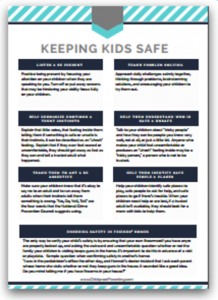
We need to help kids recognize uncertain or potentially unsafe people and situations and give them the knowledge and skills to keep themselves safe. Even though most parents worry about the potential abusers they don’t know, the most common predators are people children have met or are familiar with. It’s neither helpful nor effective to use scare tactics when educating kids about staying safe. It’s best to communicate with your children in a loving, relaxed way. Here are just a few tips for keeping kids safe from predators:
-
Listen to your child and be present.
Let your children know that they can come to you with any concern or problem without feeling judged. Practice being present by focusing your attention on your children when they are speaking to you. Turn off or put away screens that may be hindering your ability focus fully on your children.
-
Teach problem-solving skills.
Teach problem-solving skills so your child can make good choices in a precarious situation. You can do this by approaching daily challenges calmly together, thinking through problems, brainstorming solutions, and encouraging your children to try them out.
-
Teach your children to recognize their emotions and trust their instincts.
Help your children understand that their instinct is there to keep them safe. It’s that little voice, that feeling inside them telling them if something is safe or unsafe. It can be described as an “uh-oh” feeling. You can tell them their instinct might be wrong sometimes, but if it’s telling them they might be in danger or that a situation is unsafe, they should always listen to it, just in case. Explain that if they ever feel scared or uncomfortable, they should get away as fast as they can and tell a trusted adult what happened.
-
Help your child understand who is safe and who isn’t.
Talk to your children about “tricky people” and how they can be people you know very well, not at all, or just a little bit. Anyone who makes your child feel uncomfortable or produces an “uh-oh” feeling inside may be a “tricky person,” a person who is not to be trusted. Tricky people may try to get kids to “help” them, and it’s important that your children recognize this. Kids must understand that adults—particularly those they don’t know—don’t need kids’ help, and a request like this can be a clear sign of a tricky person.
-
Teach them to act on their “uh-oh feelings” and to be assertive.
Make sure your children know that it’s okay to say no to an adult and to run away from adults when their instincts tell them something is wrong. “No, Go, Yell, Tell” are the four words that the National Crime Prevention Council suggests using when teaching children what to do when “tricky people” make them feel uncomfortable. This phrase teaches children to say no, run away quickly, yell for help, and tell a trusted adult what happened. Tell your children that in these situations, manners are no longer necessary. They are allowed to hit, scream, and make a scene.
-
Identify safe people and places.
Help your children identify safe places to play, safe people to ask for help, and safe places to go if there’s trouble. When your children need help or are lost, if a trusted adult isn’t available, they should look for a mom with kids to help them.
Safe in others’ homes.
Ensuring your child’s safety in another family’s home is a significant concern of many parents. Experts say that gun violence among America’s children is an epidemic and that firearms are the second leading cause of death for children 19 years old and younger. The only way to verify your child’s safety is by ensuring that your own firearms—if you have any—are properly locked up, and asking the awkward and uncomfortable question whether or not the family your children is visiting keeps guns in the home. It’s important to do this in advance of a visit or playdate. Here are some suggestions for ways to broach the topic with another parent in a diplomatic manner:
- “I was in the paediatrician’s office the other day, and Hannah’s doctor insisted that I ask each parent whose home she visits whether or not they keep guns in the house. It sounded like a good idea. Do you mind telling me if you have firearms in your house?”
- “Susie is really looking forward to the playdate tomorrow. I know this may sound strange, and it might feel like a bit much, but could you tell me if you keep any guns in your house?”
- “My son is very curious and gets into everything. You’d be amazed by the things he’s dug up at our house that I realized later might be dangerous. I’m wondering if you have a gun in the house that he might find by accident.”
If the parents confirm that they own a firearm, thank them for telling you. Then, depending on your level of comfort, ask whether the gun is secured in a gun locker, or just tell the parents you aren’t comfortable and suggest that the kids come to your house instead. Having these conversations will not only ensure your child’s safety; they’ll also teach other parents that it’s a valuable conversation to have. If more parents have these conversations, the less awkward they’ll be.
Taking time to educate and prepare your child for the unforeseeable is not only wise but can also provide peace of mind. Children need to be taught the skills to manage uncertain situations. These are skills you can teach daily through consistent, open communication, helping children identify their feelings and listen to their intuition, and practising safety drills in response to difficult scenarios.
Would you like to have your own Guide to Keeping Kids Safe to make sure you are covering all your bases with your children?
About the Author: Melissa Benaroya
 Melissa Benaroya, LICSW, is a Seattle-based parent coach, speaker and author in the Seattle area (MelissaBenaroya.com). She created the Childproof Parenting online course and is the co-founder of GROW Parenting and Mommy Matters, and the co-author of The Childproof Parent. Melissa provides parents with the tools and support they need to raise healthy children and find more joy in parenting. Melissa offers parent coaching and classes and frequently speaks at area schools and businesses. Check out Melissa’s blog for more great tips on common parenting issues and Facebook for the latest news in parent education.



Leave a Reply