

0 items | AUD  0.00

Mindfulness – Classroom Study Shows Remarkable Results for Kids, Teens and Teachers

Mindfulness - A Recent Classroom Study Shows Remarkable Results for Kids, Teens and Teachers

Like physical health, mental health exists on a spectrum. We will all slide along that spectrum to varying degrees from time to time, and kids and teens are just as vulnerable to the dips. Increasingly (pleasingly!), research is focusing on the positive ways we can strengthen our mental health. In study after study, mindfulness meditation keeps coming up as a powerful way to do this.

What’s so great about mindfulness?

Mindfulness changes the structure and function of the brain in positive ways. Research has unlocked some of its wonders, but there will be more to come. The many positive benefits of mindfulness (and there are many!) include decreased anxiety, preservation of the brain’s gray matter (the tissue that contains the neurons), reduced depression and stress, and improved sleep quality – just to name a few.

We know that mindfulness does great things for adults, kids and adolescents, but until now, there has been little scientific proof about the benefits of incorporating a practice of mindfulness in the classroom.

Mindfulness and kids – An important study.

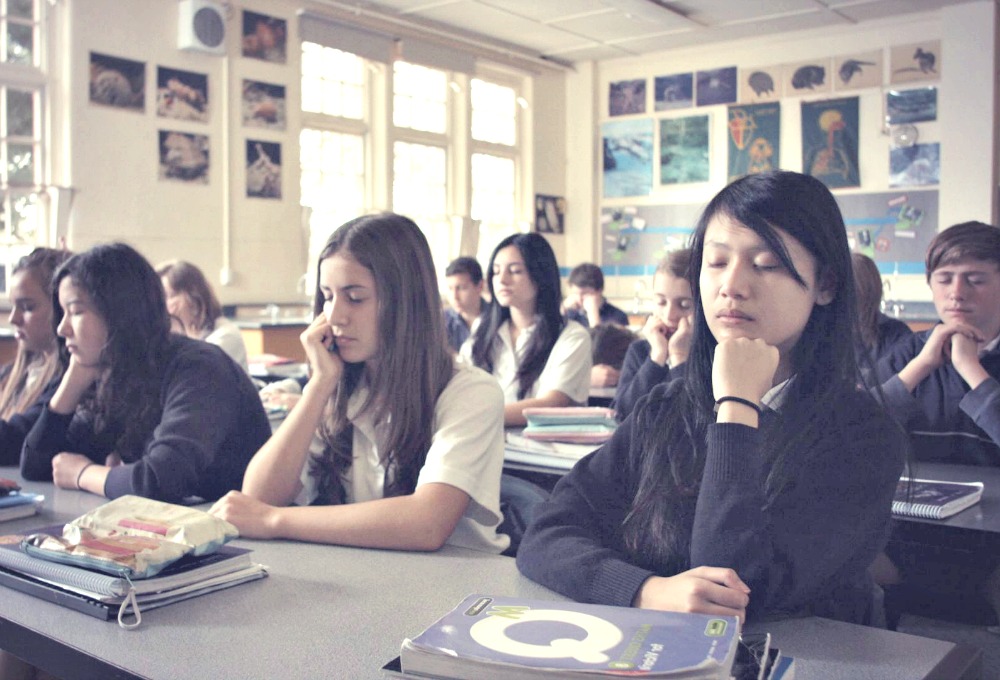
Recently, twelve Australian schools took part in a mindfulness meditation trial, to see if mindfulness could make a positive difference for students and teachers.

‘This is the largest study that we are aware of, worldwide, to evaluate the use of technology to support teachers to integrate mindfulness directly into their classrooms. The results of the study clearly demonstrate the capacity for our programs to positively impact on student and teacher wellbeing in a scalable and accessible way.’ – Dr Addie Wooten, Smiling Mind CEO.

The study involved seven inner metro schools, four outer metro schools, and one regional school. Altogether, 1853 students and 104 took part. Teachers were trained in mindfulness and the Smiling Mind program, and they participated in the five-week program. The students involved in the study were randomly assigned into two groups – one group did the mindfulness meditation and the other didn’t. Teachers and students were asked to use the program at least three times per week. 

At the end of the trial, teachers and students reported significant improvements across a number of key areas, including sleep quality, well-being, the ability to manage and accept emotions, concentration, and school behaviour. The students who reported the biggest improvements were the ones who had greater levels of emotional distress at the beginning of the program.

Importantly, there were also significant reductions in bullying and disruptive behavior in the classroom. 

Positive results from using mindfulness in the classroom have been found in a wide variety of government and non-government schools, in classes of all sizes and with kids of diverse backgrounds, locations and ages.

‘Mindfulness brings you to the present moment. It helps kids grapple with anxiety and emotions. Meditation regulates your emotions and provides a space between how you feel and how you react.’ Jane Martino, Smiling Mind founder.

But it doesn’t have to stay in the classroom.

Classroom, bedroom, home, car, outside – it doesn’t matter where mindfulness happens, just as long as it happens. The classroom is just one way to introduce a regular mindfulness practice to children but there are plenty. The important thing is to do something, and do it regularly. 

Mindfulness involves being completely present for a while. Think of it like ‘watching’ thoughts and experiences (what you see, feel, hear) come and go, rather than letting them stay for long enough to turn into a worry or a feeling that stays too long, and intrudes too much (and we all have them!). Smiling Mind has created a mindfulness app which has several different mindfulness programs. It was developed by psychologists for people of all ages and can be downloaded for free here. For other fun, practical ways to introduce kids to a regular mindfulness practice, see here.

[irp posts=”802″ name=”Mindfulness: What. How. And The Difference 5 Minutes a Day Will Make”]

9 Comments

Sushant

Mindfulness is just awesome, trying it for the past few days and now I’m able to focus more on my work.

Reply
Katy

Who conducted the study? Are there other apps that are just as useful? This seems simply to be a press release from Smiling Minds.

Reply
Karen - Hey Sigmund

Katy I understand your concerns. This is not a press release for Smiling Minds but a summary of the research paper. Funding and support for the research was provided by the Department of Premier and Cabinet and the Department of Education and Training. Prof Peter Hart from Deakin University and InsightSRC undertook all the data analysis.

There may certainly be other apps, but this research was specifically undertaken in classrooms with the Smiling Minds program. The important point is that mindfulness can make a difference for students and teachers in the classroom. There are plenty of ways to practice mindfulness, the Smiling Minds app is just one. Plenty of other research has backed up the results of this study that mindfulness can make a positive difference for kids and adults.

Reply
Jenn

Wow, that is remarkable! I am downloading the Smiling App now. 🙂

I have a question about my just turned three year old. About nine months ago we were awoken to the [very loud and unexpected] emergency alert system sounding in our apartment building during the middle of the night twice in one week. Since then my son has been very sensitive to all out of the ordinary/non everyday sounds (hammers tapping, people yelling, sounds he’s not familiar with, etc) and definitely seems to have anxiety about alarms and sirens going off. He often covers his ears and has a concerned look on his face when these sounds are present or he knows/thinks they may start.

I think (but am not sure) this is a normal reaction to the alarm going off awhile ago but the sound sensitivity seems to be getting stronger and is affecting him more and more. Is this a phobia? “Normal” toddler anxiety? Could it be SPD? (I ask that because he was a preemie and I have misophonia). I don’t know how much to acknowledge it. I definitely acknowledge when he doesn’t like a sound but i wonder if I’ve said too much. I try to be accepting of his fears and anxiety without coddling him. I guess my question is should i seek additional help for him? Just continue to acknowledge and accept his feelings? Any other advice?

I adore your website! Thank you for sharing all your wonderful insight and for all the support.

Reply
Debbie

Just downloaded the Smiling Mind app and cant wait to have my daughter do the same in the morning! Thank you so much for this post! Will see how this works for her (and me!)

Reply
Sarah

Hello, I’m also curious if the study will be written up. It leads me to dreaming of a similar study in the US.

Reply
Hazel

Hi Karen. I’m so excited to hear about this study. Do you know if Smiling Mind are going to be writing it up in a journal? It would be great if this could keep contributing to the small (but growing) body of research.

Reply

Leave a Reply

Your email address will not be published. Required fields are marked *


Join our newsletter

We would love you to follow us on Social Media to stay up to date with the latest Hey Sigmund news and upcoming events.

Follow Hey Sigmund on Instagram

Their calm and courage starts with ours.

This doesn’t mean we have to feel calm or brave. The truth is that when a young person is anxious, angry, or overwhelmed, we probably won’t feel calm or brave.

Where you can, tap into that part of you that knows they are safe enough and that they are capable of being brave enough. Then breathe. 

Breathing calms our nervous system so theirs can settle alongside. 

This is co-regulation. It lets them borrow our calm when theirs is feeling out of reach for a while. Breathe and be with.

This is how calm is caught.

Now for the brave: Rather than avoiding the brave, important, growthful things they need to do, as long as they are safe, comfort them through it.

This takes courage. Of course you’ll want to protect them from anything that feels tough or uncomfortable, but as long as they are safe, we don’t need to.

This is how we give them the experience they need to trust their capacity to do hard things, even when they are anxious.

This is how we build their brave - gently, lovingly, one tiny brave step after another. 

Courage isn’t about being fearless - but about trusting they can do hard things when they feel anxious about it. This will take time and lots of experience. So first, we support them through the experience of anxiety by leading, calmly, bravely through the storm.

Because courage isn’t the absence of anxiety.

It’s moving forward, with support, until confidence catches up.♥️
‘Making sure they aren’t alone in it’ means making sure we, or another adult, helps them feel seen, safe, and cared as they move towards the brave, meaningful, growthful thing.❤️
Children will look to their closest adult - a parent, a teacher, a grandparent, an aunt, an uncle - for signs of safety and signs of danger.

What the parent believes, the child will follow, for better or worse.

Anxiety doesn’t mean they aren’t safe or capable. It means they don’t feel safe or capable enough yet.

As long as they are safe, this is where they need to borrow our calm and certainty until they can find their own. 

The questions to ask are, ‘Do I believe they are safe and cared for here?’ ‘Do I believe they are capable?’

It’s okay if your answer is no to either of these. We aren’t meant to feel safe handing our kiddos over to every situation or to any adult.

But if the answer is no, that’s where the work is.

What do you need to know they are safe and cared for? What changes need to be made? What can help you feel more certain? Is their discomfort from something unsafe or from something growthful? What needs to happen to know they are capable of this?

This can be so tricky for parents as it isn’t always clear. Are they anxious because this is new or because it’s unsafe?

As long as they are relationally safe (or have an adult working towards this) and their bodies feel safe, the work is to believe in them enough for them to believe it too - to handle our very understandable distress at their distress, make space for their distress, and show them we believe in them by what we do next: support avoidance or brave behaviour.

As long as they are safe, we don’t need to get rid of their anxiety or big feelings. Lovingly make space for those feelings AND brave behaviour. They can feel anxious and do brave. 

‘I know this feels big. Bring all your feelings to me. I can look after you through all of it. And yes, this is happening. I know you can do this. We’ll do it together.’

But we have to be kind and patient with ourselves too. The same instinct that makes you a wonderful parent - the attachment instinct - might send your ‘they’re not safe’ radar into overdrive. 

Talk to their adults at school, talk to them, get the info you need to feel certain enough, and trust they are safe, and capable enough, even when anxiety (theirs and yours) is saying no.❤️
Anxiety in kids is tough for everyone - kids and the adults who care about them.

It’s awful for them and confusing for us. Do we move them forward? Hold them back? Is this growing them? Hurting them?

As long as they are safe - as long as they feel cared for through it and their bodies feel okay - anxiety doesn’t mean something is wrong. 
It also doesn’t mean they aren’t capable.

It means there is a gap: ‘I want to, but I don’t know that I’ll be okay.’

As long as they are safe, they don’t need to avoid the situation. They need to keep going, with support, so they can gather the evidence they need. This might take time and lots of experiences.

The brain will always abandon the ‘I want to,’ in any situation that doesn’t have enough evidence - yet - that they’re safe.

Here’s the problem. If we support avoidance of safe situations, the brain doesn’t get the experience it needs to know the difference between hard, growthful things (like school, exams, driving tests, setting boundaries, job interviews, new friendships) and dangerous things. 

It takes time and lots of experience to be able to handle the discomfort of anxiety - and all hard, important, growthful things will come with anxiety.

The work for us isn’t to hold them back from safe situations (even though we’ll want to) but to help them feel supported through the anxiety.

This is part of helping them gather the evidence their brains and bodies need to know they can feel safe and do hard things, even when they are anxious.

Think of the space between comfortable (before the growthful thing) and ‘I’ve done the important, growthful thing,’ as ‘the brave space’. 

But it never feels brave. It feels like anxious, nervous, stressed, scared, awkward, clumsy. It’s all brave - because that’s what anxiety is. It’s handling the discomfort of the brave space while they inch toward the important thing.

Any experience in the brave space matters. Even if it’s just little steps at a time. Why? Because this is where they learn that they don’t need to be scared of anxiety when they’re heading towards something important. As long as they are safe, the anxiety of the brave space won’t hurt them. It will grow them.❤️
In the first few days or weeks of school, feelings might get big. This might happen before school (the anticipation) or after school (when their nervous systems reach capacity).

As long as they are safe (relationally, physiologically) their anxiety is normal and understandable and we don’t need to ‘fix’ it or rush them through it. 

They’re doing something big, something brave. Their brains and bodies will be searching for the familiar in the unfamiliar. They’re getting to know new routines, spaces, people. It’s a lot! Feeling safe in that might take time. But feeling safe and being safe are different. 

We don’t need to stop their anxiety or rush them through it. Our work is to help them move with it. Because when they feel anxious, and get safely through the other side of that anxiety, they learn something so important: they learn they can do hard things - even when they feel like they don’t have what it takes, they can do hard things. We know this about them already, but they’ll need experience in safe, caring environments, little by little, to know this for themselves.

Help them move through it by letting them know that all their feelings are safe with you, that their feelings make sense, and at the end of the day, let those feelings do what they need to. If they need to burst out of them like a little meteor shower, that’s okay. Maybe they’ll need to talk, or not, or cry, or get loud, or play, or be still, or messy for a while. That’s okay. It’s a nervous system at capacity looking for the release valve. It’s not a bad child. It’s never that. 

Tomorrow might be tricker, and the next day trickier, until their brains and bodies get enough experience that this is okay.

As long as they are safe, and they get there, it all counts. It’s all brave. It’s all enough.❤️