


Anxiety is a normal response to something dangerous or stressful. It becomes a problem when it shows up at unexpected times and takes a particularly firm hold. When anxiety is in full swing, it feels awful. Awful enough that anticipation of the feeling is enough in itself to cause anxiety. Anxiety in kids can be especially confusing , not only for the ones who are feeling anxious, but also for the adults who care about them.
We already know that anxiety has nothing to do with strength, courage or character. It picks a target and it switches on.
When that target is a child or teen, it can be particularly distressing, causing problems with sleeping, eating and missed school from unexplained illnesses such as sick tummies or headaches.
One of the worst things about anxiety in kids is the way it can happen without any identifiable cause. The physical feeling is familiar – that panicked feeling that comes when you miss a stair or as my daughter recently described, ‘that feeling you get when you’re almost asleep and you feel like you’re falling.’ (‘Yes, we’ve dealt with it in our home too. It’s under control now, so I can assure you this works.)
The good news is that anxiety in kids is very treatable and they are particularly responsive. I often think we don’t give them enough credit. They’re so open to possibility, and very quick to make the right connections when they’re given the right information and support. As the adult in their lives, you’re the perfect one to give it.
Anxiety in Kids and Teens: Turning it Around
-
Don’t talk them out of it.
As a parent, the temptation is to reassure your child with gentle comments in the way of, ‘There’s nothing to worry about,’ or ‘You’ll be fine‘.
This comes from the purest of intentions but it runs the risk of them feeling as though there’s something wrong with them. The truth is that when anxiety has a hold of them, they can no sooner stop worrying than fly to the moon. As much as they want to believe you, their brains just won’t let them.
What they need to hear is that you get it. Ask them what it feels like for them. They may or may not be able to articulate – and that’s okay. Then, ask if it’s ‘like that feeling you get when you miss a stair,’ (or ‘that feeling you get when you feel like you’re falling in your sleep’). Often, this in itself is such a relief because ‘someone gets it.’
-
Normalise.
Explain that:
•. Anxiety is normal and everyone experiences anxiety at some time in their life – before an exam, when meeting new people, going for an interview or starting at a new school.
• Sometimes it happens for no reason at all. That’s also normal. It happens to lots of adults and lots of kids but there are things you can do to make it go away.
-
Explain why anxiety feels like it does.
Out of everything, this is perhaps the most powerful intervention for anyone with anxiety. Anxiety in kids causes the most problems when it seems to come on without any real trigger. There’s a reason for this, and understanding the reason is key to managing the anxiety.
Here is a child-friendly explanation. I’ve used it for a variety of ages, but nobody knows your child like you do so adjust it to suit.
‘Anxiety is something that lots of people get but it feels different for everyone. Anxiety in kids is common, and lots of adults get it too. It happens because there’s a part of your brain that thinks there’s something it needs to protect you from. The part of the brain is called the amygdala. It’s not very big and it’s shaped like an almond.
It switches on when it thinks you’re in danger, so really it’s like your own fierce warrior, there to protect you. It’s job is to get you ready to run away from the danger or fight it. People call this ‘fight or flight’.
If your amygdala thinks there’s trouble, it will immediately give your body what it needs to be strong, fast and powerful. It will flood your body with oxygen, hormones and adrenaline that your body can use as fuel to power your muscles to run away or fight. It does this without even thinking. This happens so quickly and so automatically. The amygdala doesn’t take time to check anything out. It’s a doer not a thinker – all action and not a lot of thought.
If there is something dangerous – a wild dog you need to run away from, a fall you need to steady yourself from – then the amygdala is brilliant. Sometimes though, the amygdala thinks there’s a threat and fuels you up even though there’s actually nothing dangerous there at all.
Have you ever made toast that has got a bit burnt and set off the fire alarm? The fire alarm can’t tell the difference between smoke from a fire and smoke from burnt toast – and it doesn’t care. All it wants to do is let you know so you can get out of there. The amygdala works the same way. It can’t tell the difference between something that might hurt you, like a wild dog, and something that won’t, like being at a new school. Sometimes the amygdala just switches on before you even know what it’s switching on for. It’s always working hard to protect you – even when you don’t need protecting. It’s a doer not a thinker, remember, and this is how it keeps you safe.
If you don’t need to run away or fight for your life, there’s nothing to burn all that fuel – the oxygen, hormones and adrenalin – that the amygdala has flooded you with. It builds up and that’s the reason you feel like you do when you have anxiety. It’s like if you just keep pouring petrol into a car and never take the car for a drive.
So when the amygdala senses a threat it floods your body with oxygen, adrenaline and hormones that your body can use to fuel its fight or flight. When this happens:
♦ Your breathing changes from normal slow deep breaths to fast little breaths. Your body does this because your brain has told it to stop using up the oxygen for strong breaths and send it to the muscles to they can run or fight.
When this happens you might feel puffed or a bit breathless. You also might feel the blood rush to your face and your face become warm.
♦ If you don’t fight or flee, the oxygen builds up and the carbon dioxide drops.
This can make you feel dizzy or a bit confused.
♦ Your heart beats faster to get the oxygen around the body.
Your heart can feel like it’s racing and you might feel sick.
♦ Fuel gets sent to your arms (in case they need to fight) and your legs (in case they need to flee).
Your arms and legs might tense up or your muscles might feel tight.
♦ Your body cools itself down (by sweating) so it doesn’t overheat if it has to fight or flee
You might feel a bit sweaty.
♦ Your digestive system – the part of the body that gets the nutrients from the food you eat – shuts down so that the fuel it was using to digest your food can be used by your arms and legs in case you have to fight or flee. (Don’t worry though – it won’t stay shut down for long.)
You might feel like you have butterflies in your tummy. You might also feel sick, as though you’re going to vomit, and your mouth might feel a bit dry.
As you can see, there are very real reasons for your body feeling the way it does when you have anxiety. It’s all because your amygdala – that fierce warrior part of your brain – is trying to protect you by getting your body ready to fight or flee. Problem is – there’s nothing to fight or flee. Don’t worry though, there are things we can do about this.’
-
Explain how common anxiety in kids is.
Anxiety in kids is common. About 1 in 8 kids have struggled with anxiety – so let them know that in their class, there’s a good chance that 3 or 4 other kids would know exactly what they’re going through because they’ve been through it before. Maybe they’re going through it right now.
-
Give it a name.
‘Now that you understand that your anxiety feelings come from the ‘heroic warrior’ part of your brain, let’s give it a name.’ Let your child pick the name and ask them what they think of when they picture it. This will help them to feel as though something else is the problem, not them. It also demystifies their anxiety. Rather than it being a nameless, faceless ‘thing’ that gets in their way, it’s something contained – with a name and a look.
-
Now get them into position.
‘The problem with anxiety is that [whatever their ‘heroic warrior’ is called – for the moment, let’s say, ‘Zep’] Zep is calling all the shots but we know that you’re really the boss. Zep actually thinks it’s protecting you, so what you need to do is let it know that you’ve got this and that it can relax. When you get those anxious feelings, that means Zep is taking over and getting ready to keep you safe. It doesn’t think about it at all – it just jumps in and goes for it. What you need to do is to let it know that you’re okay.
The most powerful thing you can do to make yourself the boss of your brain again is breathe. It sounds so simple – and it is. Part of the reason you feel as you do is because your breathing has gone from strong and slow and deep to quick and shallow. That type of breathing changes the balance of oxygen and carbon dioxide in your body. Once your breathing is under control, Zep will stop thinking he has to protect you and he’ll settle back down. Then, really quickly after that, you’ll stop feeling the way you do.’
-
And breathe.
Breathe deeply and slowly. Hold your breath just for a second between breathing in and breathing out. Make sure the breath is going right down into your belly – not just into your chest. You can tell because your belly will be moving. Do this about 5 to 10 times.
Practice before bed every day. Remember that Zep, the warrior part of your brain, has been protecting you for your entire life so it might take a little bit of practice to convince Zep to relax. But keep practicing and you’ll be really good at it in no time. You and that warrior part of your brain will be buddies – but with you in control.One way to practice is by putting a soft toy on your child’s belly when they lie down. If the toy is moving up and down, their breathing is perfect.
-
Practice mindfulness.
An abundance of scientific research has demonstrated the profound effects of mindfulness. MRI studies have shown that practicing mindfulness increases the density of gray matter in the brain, providing relief and protection from stress, anxiety and depression. See here for more information.
Mindfulness doesn’t have to be complicated. Essentially, it’s being aware of the present moment, and there are plenty of fun ways introduce children to mindfulness.
Start by explaining that anxiety comes about because of worry about the future and what might happen. Sometimes these thoughts happen in the background – we don’t even know they’re there. Mindfulness helps you to have control over your brain so you can stop it from worrying about things it doesn’t need to. It trains your brain to stay in the here and now. The brain is like a muscle and the more you exercise it the stronger it gets.
It sounds easy enough but minds quite like to wander so staying in the moment can take some practice. Here’s the how:
- Close your eyes and notice your breathing. How does the air feel as you draw it inside you? Notice the sensation of the air, or your belly rising and falling. Notice your heart beating. If your mind starts to wander, come back to this.
- Now, what can you hear? What can you feel outside of you and inside your body? If your mind starts to wander, focus on your breathing again.
Remember that anxiety in kids is very treatable but it might take time. Explain to your child that his or her very clever and very protective brain might need some convincing that just because it thinks there’s trouble coming, doesn’t mean there is. Keep practising and they’ll get there.
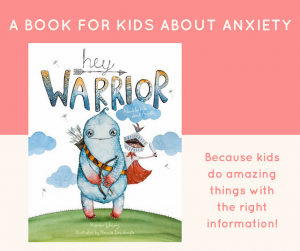 A Book for Kids About Anxiety …
‘Hey Warrior’ is a book for children to help them understand anxiety and to find their ‘brave’. It explains why anxiety feels the way it does, and it will teach them how they can ‘be the boss of their brain’ during anxiety, to feel calm. It’s not always enough to tell kids what to do – they need to understand why it works. Hey Warrior does this, giving explanations in a fun, simple, way that helps things make sense in a, ‘Oh so that’s how that works!’ kind of way, alongside gorgeous illustrations. (See here for the trailer.)



This article is very helpful! I don’t have any kids but I suffer from anxiety due to a move that I have made to another state away from family and friends to be with my partner. I like how it is broken down and explains what is going on in the brain. After reading this I am feeling very comfortable and happy. Thank you!
You’re very welcome. I’m so pleased the information was able to make sense of things for you. Information can be a powerful thing can’t it. Thank you for letting me know.
Fantastically put. My son suffers from severe anxiety with OCD tendencies and SPD. We have used all of these techniques and they work wonderfully. His anxiety is called “Tricky-Sticky” and everyday he works very hard at being the boss!
I love the name your son has given to his anxiety! I’m so pleased the techniques have worked – kids can be pretty amazing with the right information can’t they! You sound like a great team.
Thank you for posting this article. My 20 year challenged son is having some extreme difficulties with anxiety that manifests itself in extreme motor tic behavior to expend the excess energy. This article taught me a lot! I am going to sit down with him & explain some of the ways he could take back control. It is affecting his whole life at the moment. Thank you!
You’re so welcome. I’m sorry to hear that your son is struggling like this and I’m so pleased that you’re going to share the information with him. I hope it is able to offer him some comfort. If the anxiety is really taking hold, a doctor may be able to offer some relief. You sound like a great support for him.
Do you see or do much around anxiety during or after pregnancy or in babys? We have a large African community and feature pregnancy and their babys.
Many thanks
dr Nic
Anxiety can certainly take hold during or after pregnancy and in babies, though I haven’t personally worked with babies. It sounds like important work that you’re doing.
Thank you!
As a school nurse, I see kids struggling with anxiety every day, some diagnosed but most not. For some it is debilitating. I refer them to specialists, but (as another person mentioned) the wait is practically unbearable for the student and parents. I try to give them hope and explain what is happening, but now I have a new way to explain it! Thank you so much for giving me the words! I will refer to your site often and will share it with as many people as possible!
You’re so welcome. I’m so pleased the information has found its way to you. Your school is so lucky to have you!
Thank you so much for this article. My son almost 15 is in the process now being diagnosed with anxiety. It has been very difficult watching him having these attacks, but we are all doing everything we can now to help him, both at home, in school and meeting up with a therapist as well. We were thinking medication but last night we had a great talk, were I used logical explenations like you are posting in your article and I really got through it made me think that maybe we can do this without medications. So many thanks for putting it out there so simple and logical it will be very helpful in the process of taking back control 😉
You’re so welcome. Kids can do amazing things with the right information. I’m so pleased this information found its way to you. It’s wonderful that you have a relationship where you can talk and your son will listen. Keep talking – it sounds as though you are making an enormous difference.
Hi there, this is a brilliant article and it has really helped me with my son who is 6. Have you considered putting this information into an illustrated children’s book format? I have been looking for books for my son about panic attacks, and all I have found are books that touch briefly on all feelings, books about fears, and books about nervousness. None of those help when he has anxiety for seemingly no reason at all. This would be an amazing children’s book and I know many parents who would purchase it.
I’m so pleased this has helped with your son. A few people have asked for a book version so I’m working on that. Thank you for your encouragement.
Very interesting. My 8 year old has recently started to have some tics which I believe are down to anxiety as she is a ´worrier´ by character and there are a lot of changes coming up in the future. Do you think your methods can work for tics. At the moment she has a head flick and sniff … she had similar tics when she was 3 and they went away after a year. We have talked through all her worries and once we started to talk it was apparent she is bottling up a lot of anxiety. She has also started to wake a lot in the night when she has always been a good sleeper and wants to sleep in a room with her little sisters despite having her own more grown up room. Do you think your methods can help with anxiety tics?
The techniques are useful for any anxiety. It’s important to make sure that there’s nothing else going on, so I would recommend talking to a doctor just to rule anything else out. If it’s anxiety, the methods will certainly help but if your daughter’s anxiety starts to feel like it’s worsening a counsellor might be able to help her with other strategies to manage her anxiety. It’s great that you’re talking to her about her worries. It’s so important. We can all be prone to bottling things up and when we do that, things seem worse. They can also come out as physical symptoms. The more she can talk to you the better but of course, you don’t want to push too hard. Just be there – sometimes she’ll take you up on having a chat and sometimes she might not. You’re so important to her in this and you can make such a bit difference. Don’t underestimate that. Just let her talk, validate her, explain what’s happening with her body when she has an anxiety attack, try the techniques and talk through the things she’s worrying about. Things tend to grow when we keep them inside. I hope your daughter is able to find some relief soon.
Thank you for putting this in writing. I’ve used most of these techniques with my daughter, but you have explained them much better than I could!
But nobody could DO them with your daughter better than you could! I’m so pleased the article has helped.
This article has helped me. I have recently been diagnosed with anxiety disorder. It really upsets me. Now I wish there was more information for people who are surrounded by people with anxiety who are not children how they can help the person with anxiety.
Because I find it very frustrating and upsetting when people around me do not know how I am feeling and they tell me I am just being stupid and silly and must grow up because I am acting like a baby.
So hopefully people can learn now how and what to do with people when they having an anxiety attack.
I’m pleased the article has been able to help you. It’s very hard to understand what anxiety is like unless you’ve actually been there isn’t it. It’s so important that we keep the conversation about anxiety keeps going. There are just so many people struggling with it and it deserves the understanding and respect. Thank you for taking the time to add your voice.
Thank you for the wonderful advice. My daughter was just diagnosed with anxiety and we are in the process of trying to get her help. As frustrating it is, waiting 2 weeks to try and get her an appointment, this article is giving me the tools to help her and understand what she is going through.
You’re so welcome. I’m so pleased this is able to help your daughter. The wait can be so frustrating can’t it. I’m sure it will be worth it though. Thank you for taking the time to let me know. All the best with your appointment.
I wanted to thank you for this great post. I had read it last week and ended up using the strategies almost exactly as you described with my 9 year old daughter last night. What initially was a lot of stress/fear/nervousness/run away from an opportunity, became an education in how normal feelings of anxiety are, the fight or flight mechanism, and giving funny names to her amygdala and the more cerebral parts of her brain. She finally said, “ok I understand it but I can’t focus long enough to make the right decision”! Then it was time to implement the deep breathing and mindfulness. After a few minutes, she was able to make a decision based on how she really analyzed a situation instead of being scared and wanting to avoid the whole thing. I am so proud of her because she gained self esteem knowing she can overcome her fear when she needs to. It was a small life experience but I truly believe it will help her in the future. Thanks again being a great resource!
You’re so welcome. This is wonderful! I’m so pleased the information found its way into your hands, and that you shared it with your daughter. Kids can do such amazing things when they’re given the right information. What a great team you both are.
As a bereavement services counsellor of children I often work with children who suffer with anxiety problems as a result of their loss. I loved your article and the toast analogy is great. I always explain what the amygdala is doing as understanding why they feel the way they do is really helpful. Sometimes we have imagined reaching round to the back of the head and then holding it in the palm of the hand, while imagining it is a trembling little mouse. Gently stroking this imaginary creature has proved a helpful visualisation , and on occasions we have even painted a small stone to look like a mouse, so they can reach for it at bedtime if they start to feel panicky, and then stroke it to calm it down. That in itself seems to slow the breathing, without having to think about it too much.
Oh this is so wonderful! I love this. Thank you so much for sharing.
Thank you so much!!. I couldn’t read all the comments but saw some with similar experiences so if our experience helps just one family then I’m glad I shared…
Our 11yo son suffers from anxiety. The peak of his symptoms became apparent at 9 when he began plucking his eye lashes. The worst it got to was no eye lashes, no eye brows and a bald patch at the front of his head. Not something he could hide at school! The anguish & anxiety we felt as parents at that point made it hard for us to focus on the right ways to deal with it.
The things that worked in the end were:
. Seeing a therapist who specialised in anxiety in kids and spoke the right language. I’ve discovered that you have to find the right one for your child… They are not made out of a cookie cutter 😉
. Using very similar talking about exactly what anxiety is as mentioned in your article
. Using relaxation techniques at bedtime and other random times eg yoga nidra, meditation, yoga, smiling mind, breathing exercises
.talking, talking and talking… But not forced just presenting plenty of opportunities to discuss stuff
. Exercise… Doing it with him… Which provides those extra random talking times
.he will always have a tendency towards anxiety so if we can arm him with the right tools imagine what he can achieve as an adult!!
A large part of this journey has involved guilt on my behalf. I plucked hair at 17, I tried to take my life at 18 (in a very half arsed way), I had post natal depression and many more other anxiety related happenings.
It wasn’t until last year when I suffered from severe anxiety including panick attacks and vertigo that I really felt like I was the boss of it. One thing my therapist told me about the breathing part that might help some readers is that she said imagine it’s like a tap you need to turn on. It will only come on if you breathe right to your belly.
Another thing that ‘fixed’ my severe anxiety was meditation.
I noticed a couple of you mentioned moving. We moved six months ago from Australia to Hong kong. It caused a bit of regression in our son but the young lad we have under our roof right now is VERY happy has a confidence we didn’t expect so quickly. The move (as we hoped) has opened his world in a very good way. The process involved a lot of his involvement in appropriate decisions and respect from us to give him the space to process. Plus pushing him slightly out of his comfort zone at points – these are the things that have most helped his confidence.
I wish you all the best and feel blessed to know this is such a caring community…because some people just don’t get it.
Thank you so much for sharing your story! It’s so great to hear other people’s experiences because as you say, you just don’t know what’s going to work. You’re right – we do seem to have a wonderful community taking shape here. Thank you for being a part of it!
I loved your article and shared it straight away on my business page.
I teach mums to massage their babies and older children weekly, throughout their childhood. It has transformed my relationship with my children.
In my courses I go in to so much detail about the stress response and basically explain what you explained so well.
The primary benefit of massage is relaxation ie not a stress response, so not only are you helping your child physically, but emotionally, as you are there with them during the massage time.
I found that it is always when I was massaging them, that’s when I found out their worries and concerns and pre-empted their anxieties before they could take hold.
My passion would be to see every mum massaging their child once a week, to help stop anxiety and to allow that regular special one to one time with their child.
Thank you .
Thank you for sharing this.
My daughter was diagnosed 2 years ago when she started secondary School with severe anxiety. It was the most scary & horrible time for both her & me & my husband. Her school & their school councilors were fantastic & slowly re introduced her back into school life. 2 years down the line & now dealing with hormones/periods etc we still have bouts of anxiety, but now she can recognise the signs & although sometimes feels as if she cannot cope she manages to get through them. She recently has started to have panic attacks which are very scary to her but we do lots of talking & she knows there are many triggers that can bring these on and we are still trying to figure out the best way to deal with those. I am so very proud of her because she has had some awful times because of anxiety but it seems the older she is getting the more she is starting to understand herself & what works best for her.
It’s so awful to watch them struggling like this isn’t it. It sounds as though your daughter has great insight and has developed some pretty amazing ways to cope. I love hearing how proud you are of her – it must mean a lot to her when she hears it too!
This article brings such clarity and comfort to me, as I have suffered from anxiety and panic for 35 years. Now, my daughter (age 8) is having panic attacks, and I was fortunate enough to identify them right away. But identifying panic and knowing what to do for someone who is panicking are entirely different! No one ever helped me with my anxiety as a child, so I am exploring unknown territory as I seek ways to help her.
I’m commenting, however, to tell “HeySigmund” THANK YOU for responding so sensitively and intelligently to all of our posts. Anxious people feel so much better knowing they are not alone and they are important, and you have done exactly that by responding so thoughtfully to your readers. On behalf of us anxious folks (and parents of anxious little folks) around the world: BIG GRATITUDE. Huge gratitude. Thank you.
You’re so welcome. And thank you! I feel like this is such an awesome community we’re building here. People are being so open and honest with their comments and I know it’s helping other people. I hope everyone who takes the time to write feels important. They’re certainly important to me.
excellent article – off to share on our campaign page. keep up the great work.
Thank you!
Thank you for taking the time to respond to all of the responses to your blog. It is rare and thoughtful.
Thank you. It means so much to me that people are taking the time to respond and share their important stories.
I am a 13 years old and one of my family members recommended I read this article. I’ve had anxiety for years and at times, it’s taken over my life. I could really relate to this! When you daughter said she feels like she’s falling in her sleep, It happens to me when I’m light sleeping regularly aswell. I’ve seen many different counsellors but I never really felt like it’s changed. While reading this I thought that it was helping me a lot more by putting everything infrint of my eyes. Thank you sincerely.
You’re welcome. I’m so pleased this has been able to help you. Thank you for taking the time to let me know.
Article is great but it glosses over main issue, why kids have anxiety. In my 6 yr old case it was sensitivity to artificial food additives and solicilies. We tried fainghold diet with great sceptisism for 6 weeks. The results amazed doctor and therapist. He hasn’t had aymptoms in 6 months. No therapy. Just diet exclusively from whole foods and low solicilies. It is greatly researched and used in australia and is reccomend by some dietitians in US. Before anything I would recommend diet change. It changed out family life and helped my son to the point where he has no symptoms which eliminates the whole coping part.
Thank you for sharing your story.
I’ve been suffering from anxiety since I was about 6. I’m 20 now, halfway through a degree, and gradually learning to put myself out there and fight the fear that’s been filling my brain for so long. Recently my doctor prescribed me propanolol (beta blockers) to help with the more physical symptoms. I also use mindfulness meditation and self taught CBT techniques, and I’m currently looking for a CBT therapist.
Reading this article was a revelation – I’m lucky to have very supportive parents but of course it was impossible for them to know what was going on in my head. This helped me to see their position more clearly, and to be honest with myself and that little 6-year-old inside about how I’m feeling. Thank you. And to all those parents – it does get easier, and you are making a difference!
Beautifully said!
This is very timely because my 92 year old father had a panic attack last night. Reading your article has helped calm me down, and I will be able to understand and help him better now. Thank you
You’re welcome. I’m very pleased the information found its way to you. It’s hard watching people you love go through something like that isn’t it. I hope he is doing okay.
This is fabulous. My husband and 7 yr old son struggle with anxiety. I read it to my husband and he was able to make some sense of what he has been dealing with most of his life. It also helped me to understand and normalize what is actually happening rather than dismissing it as irrational. It will definitely help us both as we guide our son through this. Bless you for writing such a helpful article illustrating anxiety.
Thank you! I’m so pleased the information found its way to you. It sounds as though your son is in wonderful hands!
My 10 yr old has all of the symptoms of anxiety. She starts to complain about her tummy hurting and crying as soon as I mention anything different is going to happen. ie: A friend is going to spend the night, we are having people for dinner, or if I want to move anything around in the house. Is OCD linked to anxiety? She also has to have her pillows and blankets exactly the same every night. She goes nuts if you leave her bedroom door open, because the smells of the house get in her room, and once we have done something as a family, she wants us to do it exactly the same way net time… Are these two different issues or are they all related?
Oh this sounds like classic anxiety. There are different types of anxiety and OCD is one of them. OCD is where people behave in such a way (compulsions – e.g. having her pillows and blankets exactly the same every night) to alleviate a distressing thought (obsession – e.g. something bad might happen if I don’t have my pillows exactly right.) Here is a link to some information about OCD. It’s from Beyond Blue – a great resource and certainly one you can trust … https://www.bspg.com.au/dam/bsg/product?client=BEYONDBLUE&prodid=BL/0507&type=file. I hope this helps to sense of things for you and I hope your daughter is able to find some comfort soon.
Thanks for this. I’m yet to read it fully to see if I can help my 4 year old. It’s usually bed time but it can happen any time. The breathing has made me think that perhaps yoga may help her too, thank you
You’re welcome. Breathing is such an important part of reversing the fight or flight response. It makes good sense that yoga would help. I will be doing a post about dealing with anxiety in younger children, so stay tuned for that. Thanks for taking the time to make contact.
Have you heard of the MindUP program? We use it in our PreK room with children ages 3 to 5, but it’s designed for children 3 to 13. It starts by teaching children about how their brains work focusing on the amygdala, PFC, and hippocampus’s roles, then goes on to teach breathing and a whole host of other strategies that help children both understand and support what’s going on in their bodies in times of stress. So much of what you talk about in this article mirrors what we use, I had to ask.
It’s just amazing to see how learning these tools is so incredible empowering to children. Thanks for writing this article! It’s wonderful!
No – I’ve never heard of it. How wonderful that this is being taught to kids at such a young age. Having the right information is so powerful isn’t it! Thank you for taking the time to let me know about it.
I am 25 years old and used to suffer badly from serious panic attacks with some dissacociation. I had PTSD and have been well taken care of for the last two years by some amazing therapists at a trauma center. I still get some panic attacks.
Thinking about all the comments about teens, as corny as this sounds, when I was younger I found complex music to be really helpful. Bands like Muse, Within Temptation, Trans Siberia Orchestra etc have a really big sound with a fairly strong beat. When you’re sitting in the middle of the attack trying to force yourself to relax, having the distraction of the complex sounds and the beat to encourage you to breathe helps. (Also, I like to sing, which is really hard when you’re not breathing).
For kids that have trouble sleeping due to anxiety, I had a set of CD’s (I think they’re available digitally now) that were water based called Tranquility (I had Forever Rain and Zen Garden). These again are sensory rich: tell your kids to think of the setting the these sounds are coming from. The imagination (what does it look like, smell like) is something I still do when I “feel sick, dizzy, like I’m falling”. People talk about their “happy place” as a joke, but the forest and the garden that I imagine when I listen to those two helps.
Loved the article and as a biology/nursing major, this was helpful. I learned my techniques before I could have understood what was happening, hopefully it helps with younger kids that might not get it.
It’s great to hear what’s worked for other people because you just never know who else it could help. I don’t think listening to music sounds corny at all. I think it’s a great idea and it makes complete sense to me. You’ve learned some really clever ways of coping. Thank you for sharing your wisdom and insight.
Thankyou I will give this a try with my 10 year old son. He has a hard time getting to sleep and after reading you article I’m thinking it is probably his anxiety keeping him awake.
Thanks for this fantastic article on childhood anxiety, which my son has suffered from on and off for the past four or so years.
I really like the idea of explaining the part of the brain that’s causing the fear, and giving it a name. And rather than making it a scary character, calling it a ‘protector’ is a great way of putting it in perspective.
We’ve gone through the deep breathing exercises and explaining the fight or flight response etc, but probably haven’t been consistent enough with these explanations, so thank you for reminding me to normalise his feelings, empathise with him and break it down for him to understand. Excellent advice. 🙂
You’re very welcome. It’s so important to understand what we do (even those things that trip us up!) as a strength and adaption, rather than as a dysfunction. You sound like wonderful support for your son.